
In 2016 I started a fintech company called JRNY. I had a product background and zero sales experience, and by the end of year one we had $30k in annual revenue, I'd taken myself off salary, and I was living on savings.
With nothing else left to try, I committed to properly learning sales. Six months later we were at $500k ARR, and in 2020 JRNY was acquired.
What changed in those six months was how I worked (I certainly didn't get any more charming). I stopped collecting tactics and started running a sales system, doing the same steps in the same order every week. That's what a sales system for solo consultants needs to be: simple enough to run on your own, and clear enough that you can see which part broke when things go quiet.
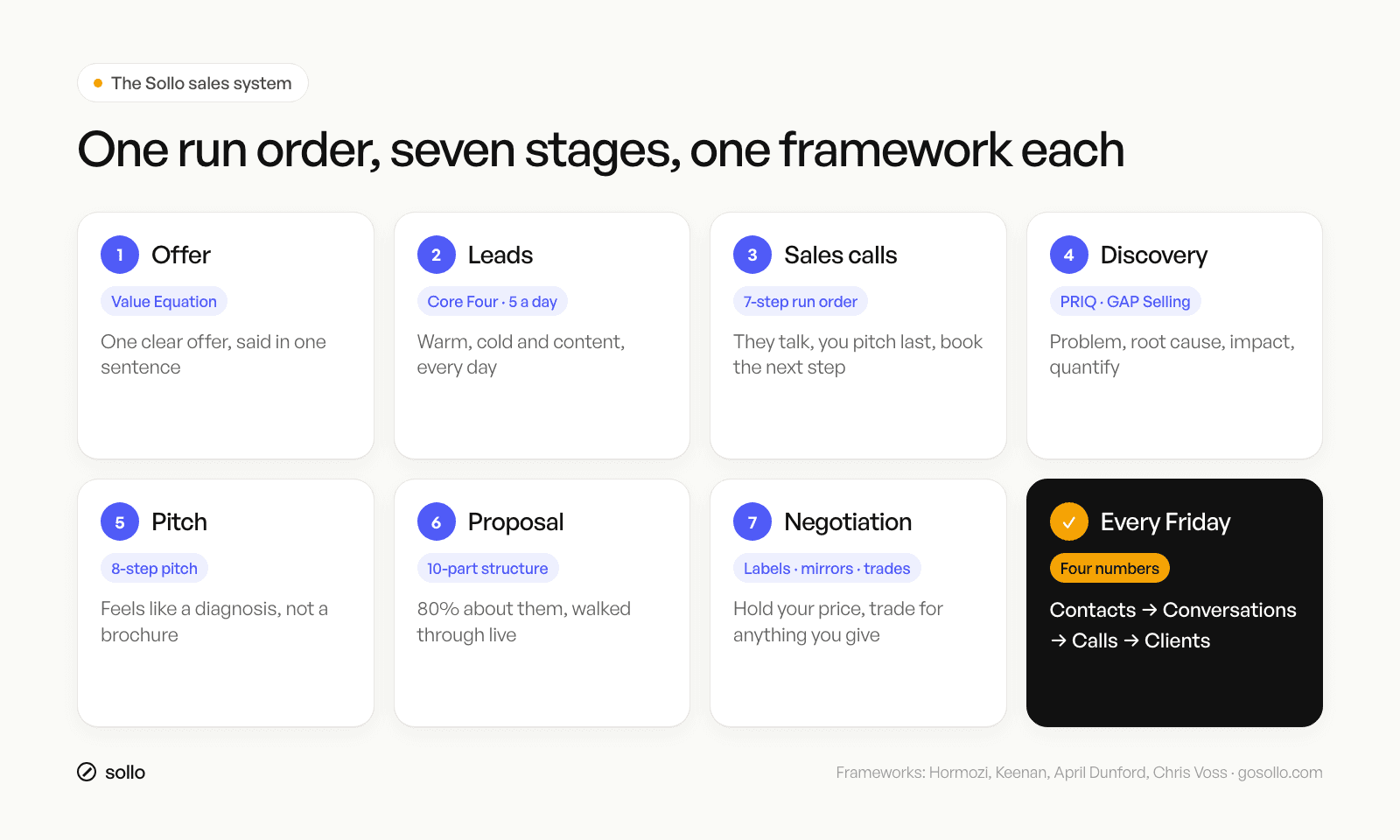
What follows is the whole map, with the seven stages, the framework I use for each one, and something you can do today to put it into practice.
TL;DR: A sales system for solo consultants is seven stages run in the same order every time: offer, leads, sales calls, discovery, pitch, proposal and negotiation, with one framework for each. Track four numbers every Friday (contacts, conversations, calls, clients) so you can spot the broken stage, fix it, and keep your pipeline predictable.
What should a solo consultant's sales system look like?
A solo consultant's sales system should be a fixed run order you can operate alone in about an hour a day: one clear offer, a daily lead habit, a structured call, deep discovery, a tailored pitch, a proposal walked through live, and calm negotiation. Every stage has one framework and one number, so problems show up early.
There's nothing in there that needs an enterprise methodology, a team of SDRs or a stack of tools duct-taped together. You're one person, so the system has to fit around your client work, and the seven stages simply follow the buyer from "who's this?" to "where do I sign?".
Why do most solo consultants learn sales backwards?
Most solo consultants learn sales backwards because they pick up tactics first: a cold email template, an objection script, a closing line. They try one, it doesn't work, and they jump to the next. Without a run order, you can't tell whether the tactic failed or a stage further upstream did, so nothing improves.
I see this all the time. Someone's proposals aren't converting, so they buy a new template, when the real trouble started earlier: discovery never found a real, quantified pain, so the proposal had nothing to stand on.
Once you use the same run order every time, a lost deal stops being a mystery, because you can ask yourself a few plain questions. Did I get a number in discovery? Did I book the next step? Did I send the proposal before walking them through it? One of the answers will usually be no, and that tells you what to fix.
Tactics are still useful (I use plenty of them), they just work far better once they sit inside a system.
How do you get out of the feast or famine cycle?
You get out of feast or famine by protecting a small, daily lead habit that keeps running while you're busy delivering. The cycle happens because solo consultants sell hard when they're empty, then stop when they're full. A system with a non-negotiable daily minimum keeps the pipeline filling during the busy months too.
You probably know the pattern. You land two clients, you're flat out delivering, and outreach drops to zero, then three months later the projects end and you're back to panic selling: discounting, saying yes to bad-fit clients and inventing a new package on every call.
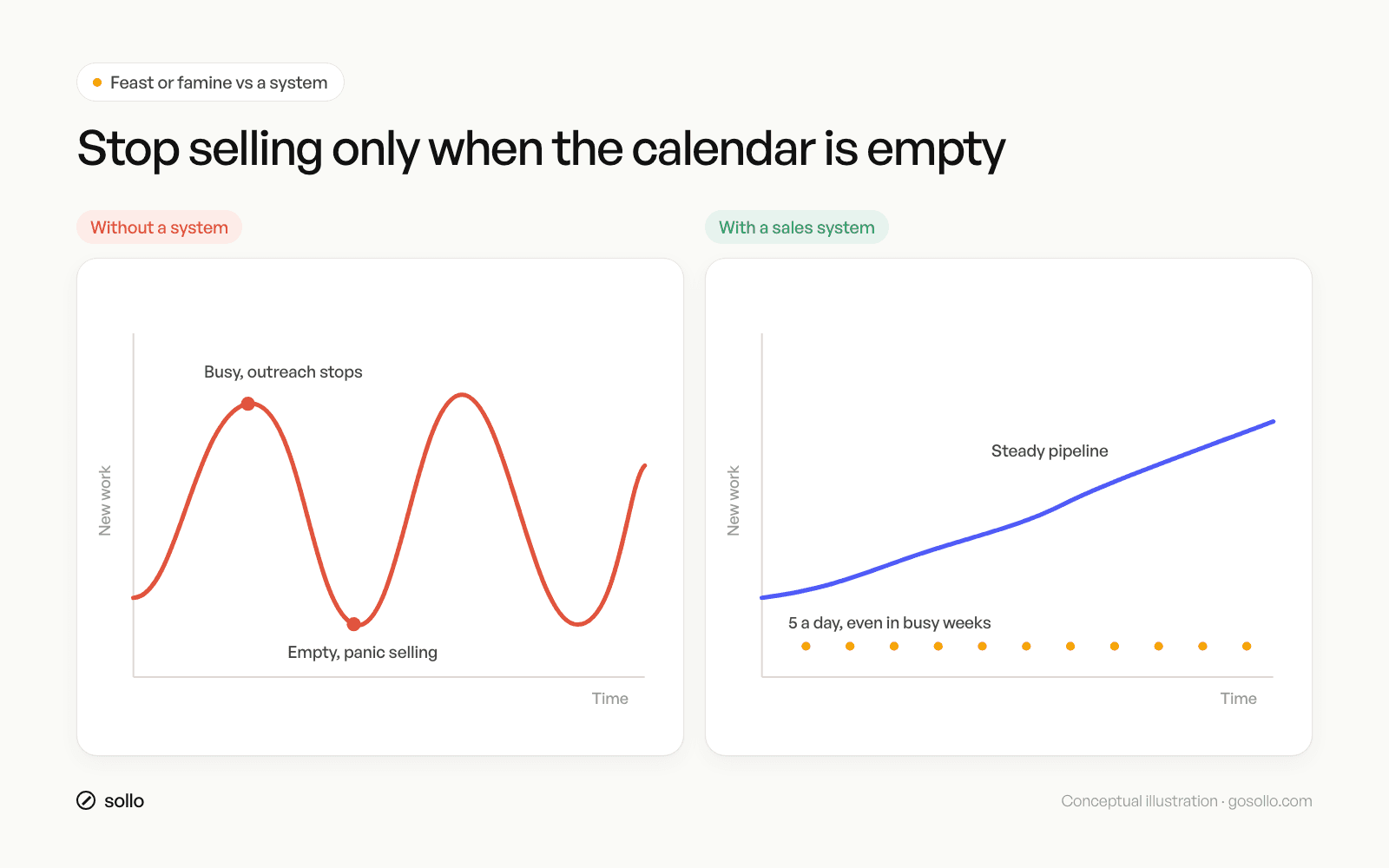
What fixes it is a small amount of effort that never stops. My rule is 5 new, personalised conversations a day, even in your busiest week, which takes about 30 minutes. It's boring, but it works.
What are the 7 steps of a sales system for solo consultants?
The seven steps are: define one clear offer, find leads with a daily habit, run a structured sales call, go deep in discovery, pitch like a diagnosis, write a proposal about them and walk it through live, then negotiate without dropping your price. Each step has one named framework and one action you can take today.
Each one gets a short summary below, with a link to the full lesson if you want to go further.
Step 1: Offer (the Value Equation and your one-line intro)
Everything in sales sits downstream of your offer, so if every call ends with you inventing a new package on the spot, the offer is the thing to fix first.
Use Alex Hormozi's Value Equation from $100M Offers: value goes up with the dream outcome and the buyer's belief it'll work, and down with time delay and effort. Then sum it up in one line: "I help [who] get [result] in [timeframe] without [the thing they hate]."
Do it today: write your one-line intro and say it to five people this week. Full lesson: how to create an irresistible offer.
Step 2: Leads (the Core Four and 5 a day)
There are only four ways to let people know you exist: warm outreach, cold outreach, content and paid ads. As a solopreneur, start with the first three and leave ads for later.
Write your ideal client profile in four lines (who it's for, who it's not for, their stage, their struggle), then reach out to 5 new people a day with each message written for them. Expect it to take time, too, because the 7-11-4 rule of thumb says most buyers need about 7 hours, 11 touchpoints and 4 mediums before they buy.
Do it today: list 50 people you know and message 10 of them personally. Full lesson: how to find clients as a consultant.
Step 3: Sales calls (the 7-step run order)
A great sales call follows a fixed order: set the scene, understand the problem, find the root cause, uncover the impact, quantify the pain, summarise until they say "that's right", then give a short tailored pitch and book the next step.
The prospect talks for at least half the call, and you don't pitch before step 6. Do it today: after your next call, score yourself on three questions. Did I set the scene? Did I get a number? Did I leave with a date in the diary? Full lesson: the sales call structure.
Step 4: Discovery (PRIQ and GAP Selling)
Discovery is where deals are won. Its job, as Keenan puts it in GAP Selling, is to find the gap between where the buyer is now and where they want to be, and we use four letters to get there: Problem, Root cause, Impact, Quantify.
Never accept the first answer, because the real problem is usually a question or two further down. Do it today: write six questions on a card, at least one per PRIQ stage, and use them on your next call. Full question bank: discovery call questions.
Step 5: Pitch (April Dunford's 8 steps)
The best pitches feel like a diagnosis. April Dunford's structure from Sales Pitch runs: insight, alternatives, the perfect world, introduction, differentiated value, proof, objections, the ask.
Your biggest competitor is usually doing nothing. Matthew Dixon and Ted McKenna found in The JOLT Effect that 40% to 60% of buying processes end in no decision, so your pitch has to make the case for change.
Do it today: storyboard your pitch in eight boxes and practise it out loud three times. Full lesson: how to pitch your services.
Step 6: Proposal (the 10-part structure)
Nobody signs a proposal that's all about you, so aim for roughly 80% about them and 20% about your solution: their current state, their future state, what's at stake, then your tailored solution, timeline, one matched case study, investment and a prescribed next step.
Walk them through it live before you send it. Do it today: count the pages about them versus about you in your last proposal. Full lesson: how to write a consulting proposal.
Step 7: Negotiation (labels, mirrors and trades)
Hold your price and trade for anything you give. Chris Voss's tools from Never Split the Difference do most of the work: an accusation audit, labels ("it sounds like budget is the main worry"), mirrors, calibrated questions, and summarising until you hear "that's right".
A lower price should always come with less scope, a longer term or payment upfront in return, and a clean no is better than a bad client.
Do it today: decide your trades before your next pricing conversation. Full lesson: how to handle price objections.
If you want the worksheets, scripts and templates for every stage in one place, they're all in the free Sollo Sales Vault.
How do you know which part of your sales system is broken?
Track four numbers every Friday: contacts (new people you reached), conversations (people who replied), calls (discovery calls booked) and clients (deals closed). Where the drop-off between two numbers is worst is the stage to fix. Low replies point to your message or offer, while plenty of calls and no clients point to your calls, pitch or proposal.
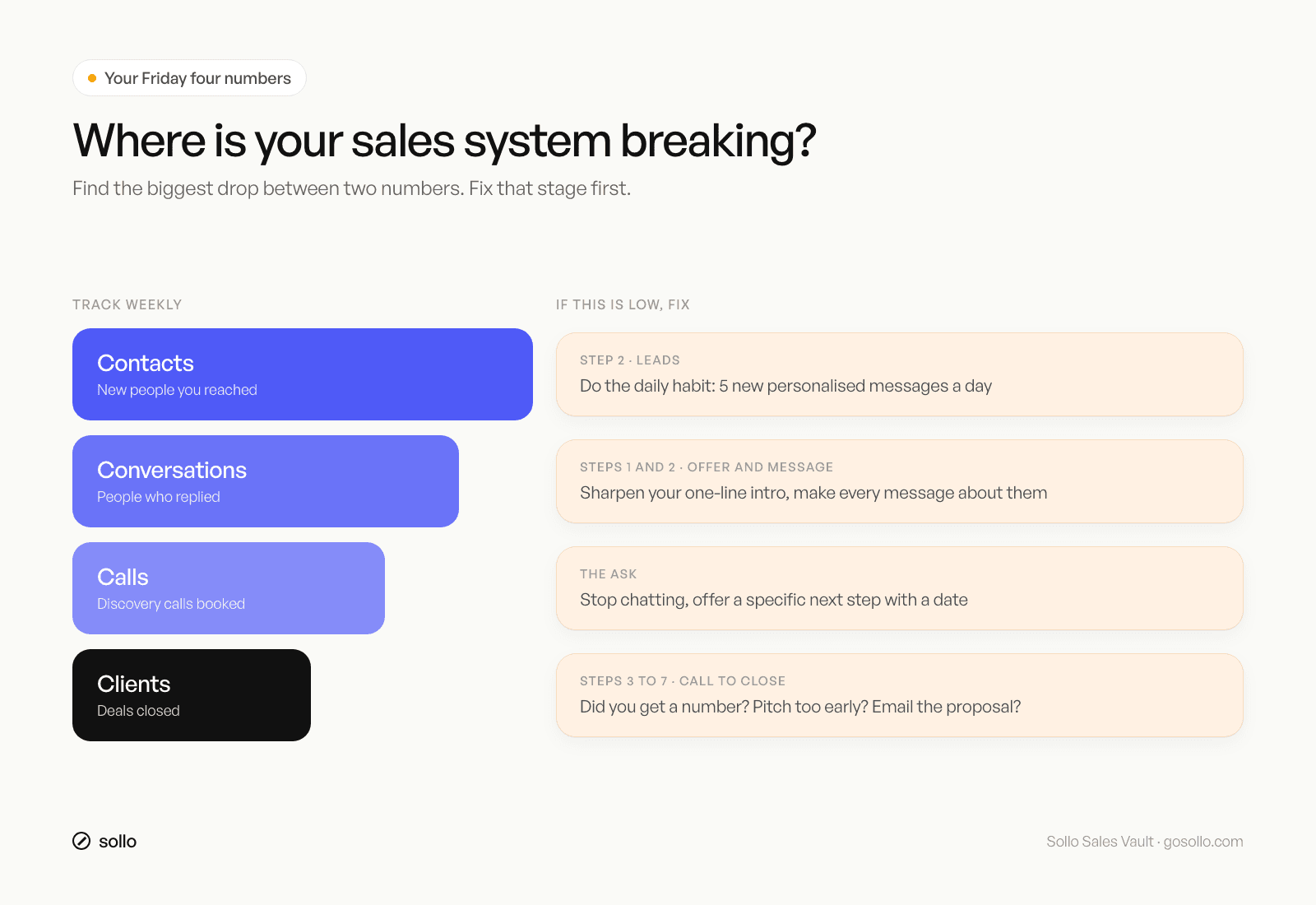
Contacts are low. You're not doing the daily habit. Fix Step 2: block 30 minutes a day for 5 new people.
Contacts are fine, conversations are low. Your message isn't landing, or your offer isn't clear. Personalise harder and sharpen your one-line intro (Steps 1 and 2).
Conversations are fine, calls are low. You're chatting but never asking. Offer a specific next step with a date.
Calls are fine, clients are low. The problem is on the call or after it. Check whether you got a number in discovery, whether you pitched too early, and whether you sent the proposal without a walkthrough (Steps 3 to 7).
Fix one stage at a time, or you'll never know which change worked.
How do you scale a solo business predictably?
You scale a solo business predictably by learning your own conversion rates between the four Friday numbers, then working backwards from the revenue you want. Once you know roughly how many conversations turn into a call and how many calls turn into a client, growth comes down to inputs you control and much less to luck.
Say your numbers over a couple of months show that about one in four discovery calls becomes a client. If you want two more clients a month, you know you need around eight calls, and from there you work out how many conversations it takes to book a call, and so on back to your daily outreach.
Some months will still be better than others, but you'll know which lever to pull when one comes in light.
Is jumping between tools killing your sales productivity?
Often, yes. When your leads live in LinkedIn, your notes in a doc, your follow-ups in your head and your pipeline in a spreadsheet, things fall through the cracks between conversations. For a solo consultant, the cost goes well beyond time: it's the follow-up you forgot and the deal that went cold without you noticing.
Most solopreneurs I talk to run sales across five or six tabs: a prospecting tool, the LinkedIn inbox, Gmail, WhatsApp, a spreadsheet and a notes app. The gaps between them are exactly where deals die.
A big team CRM built for 50 salespeople would be overkill, but having one place where the person, the conversation, the notes and the next step all live together makes a real difference. If you're weighing that up, read do solopreneurs need a CRM? and spreadsheet vs CRM.
How do you start running the system this week?
Start with whichever stage your Friday numbers say is weakest, rather than defaulting to Step 1. If you have no numbers yet, write your one-line offer on Monday, start 5 new conversations a day from Tuesday, use the 7-step call run order on every call, and record contacts, conversations, calls and clients on Friday.
This weekly rhythm fits comfortably around client work:
Every day (30 minutes): 5 new personalised messages, plus replies to anyone who's engaged with you.
Before every call (10 minutes): review their notes, pick your questions.
After every call (5 minutes): write notes and book the next step before you close the tab.
Friday (15 minutes): record your four numbers and pick one stage to improve next week.
FAQ
What is the best sales process for solopreneurs?
The best sales process for solopreneurs is one you'll actually run every week. A simple seven-stage process works well: offer, leads, sales calls, discovery, pitch, proposal and negotiation. Keep one framework per stage, track four numbers weekly, and improve one stage at a time rather than chasing new tactics.
How do I sell consulting services if I hate selling?
Most people who hate selling really hate pitching at strangers, and a good system flips that around. You ask questions, listen more than you talk, and only pitch once the prospect has told you why they need help. Selling becomes a conversation about their problem, which most consultants are naturally good at.
What numbers should I track to build a predictable pipeline?
Track four numbers every Friday: contacts (new people reached), conversations (replies), calls (discovery calls booked) and clients (deals closed). The ratios between them show which stage of your sales system is broken, and over time they let you work backwards from the revenue you want to the daily activity you need.
Do I need all seven stages if I get most clients from referrals?
Yes, because referrals are amazing until they stop, and they always seem to stop at the worst time. Even referred clients still go through a call, discovery, a pitch, a proposal and often a price conversation. Running the full system means you convert more of your referrals and aren't stuck when they dry up.
How can Sollo help?
Sollo is the sales platform built for one-person businesses, and it's built around exactly this system. You set up your offer once, and it shapes your outreach and your proposals. You find leads that match your ideal client profile, and every conversation across LinkedIn, email and WhatsApp lands in one inbox, with reminders of who to follow up with.
Your pipeline shows every deal and its next step, and the AI sales agent drafts outreach, preps your calls, builds proposals from your discovery notes and coaches you on what to say next. As Clare Kitching, an AI consultant, put it: "I thought I had about $180k of deals in play. It was closer to $400k. I've since written six proposals in three weeks and already won two."
The whole system lives in one place, which is exactly what you need when you're the only person running it.