
My first client after I left Fresha to go solo was a B2B SaaS founder who had plenty of leads coming in and hardly any of them turning into customers.
I could have jumped straight in with a pitch about sales training, but instead I spent most of our first call asking discovery call questions. By the end of it we'd both worked out exactly where the leads were leaking and what it was costing him.
That call turned into a $37,000 deal, and the questions did most of the selling.
When you understand someone's problem better than they do, the sale almost makes itself. This post gives you the exact framework and the 20 questions I use to get there.
TL;DR: Good discovery call questions find the gap between where your prospect is today and where they want to be. Use the PRIQ framework (Problem, Root cause, Impact, Quantify), then paint the future state. Keep digging past the first answer, mirror and label what you hear, summarise it back in their words, and only pitch once they say "that's right".
What is a discovery call really for?
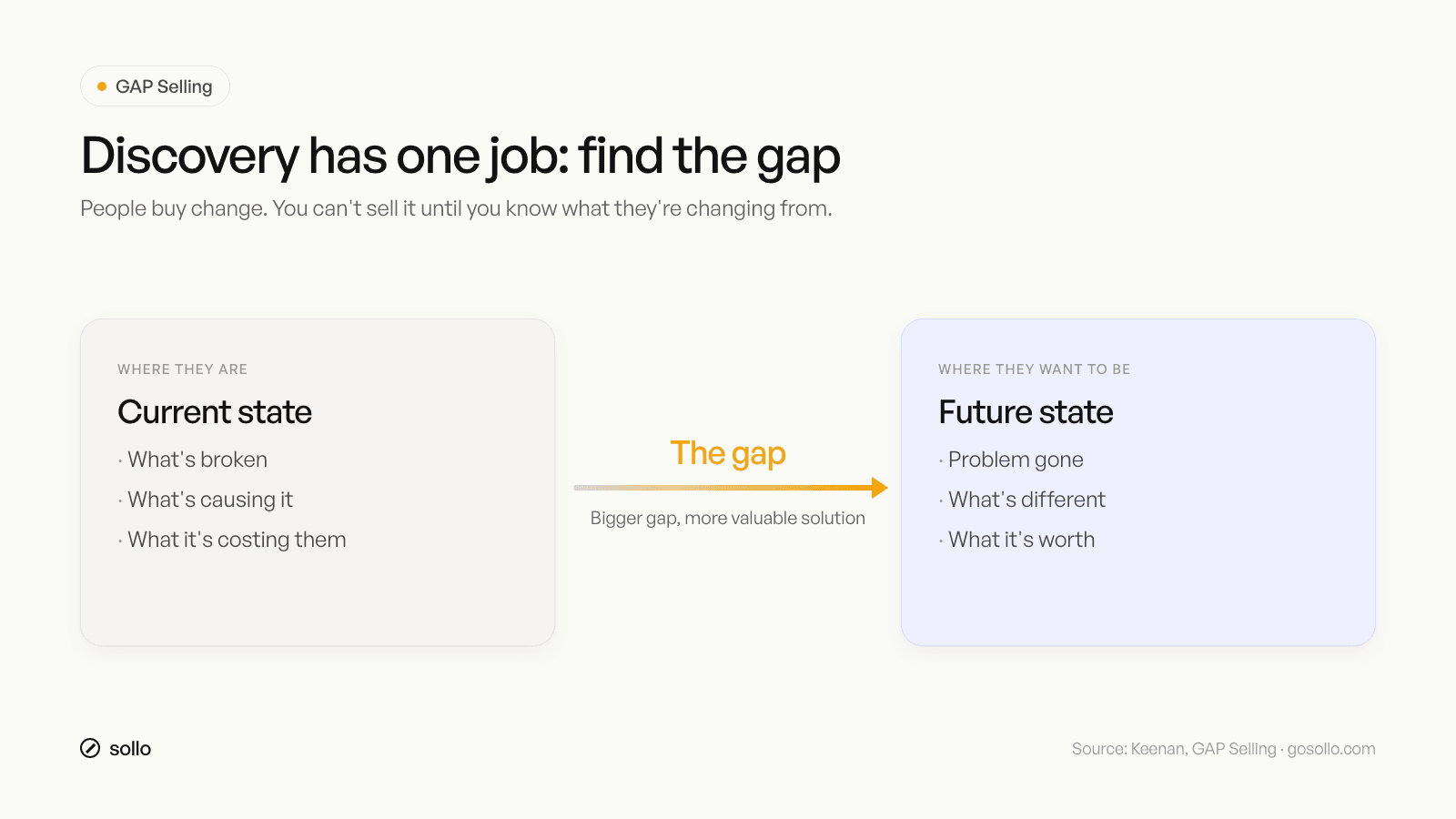
A discovery call exists to find the gap between your prospect's current state and their desired future state. The current state is what's broken and what it costs. The future state is life once it's fixed. The bigger that gap, the more valuable your solution, and the easier it is for them to say yes.
Keenan calls this GAP Selling, and it's the backbone of how I run every first call. There are three pieces to map:
Current state: what's happening right now, what's broken, and what it's costing them.
Future state: what life looks like once the problem is fixed.
The gap: the distance between the two. The bigger the gap, the more valuable your solution.
People buy change, and you can't sell change until you know exactly what they're changing from.
Most consultants skip this part. They hear a problem and start pitching within ten minutes, the prospect nods along and says "send me something", and then they go quiet.
Why does the first answer never tell the whole story?
The first answer a prospect gives you usually describes a symptom rather than the cause. "We need more leads" can mean no pipeline at all, plenty of pipeline with a terrible close rate, or a great close rate with a pricing problem. Each needs a different fix, and you only find out which by asking follow-up questions.
Imagine three people walk into a doctor's surgery with a headache. The first one just needs a coffee, the second has a massive deadline tomorrow and is stressed out of their mind, and the third has something far more serious going on.
They all have the same symptom, but three completely different problems. If the doctor stops at "headache" and treats all three the same way, two of them walk out worse off.
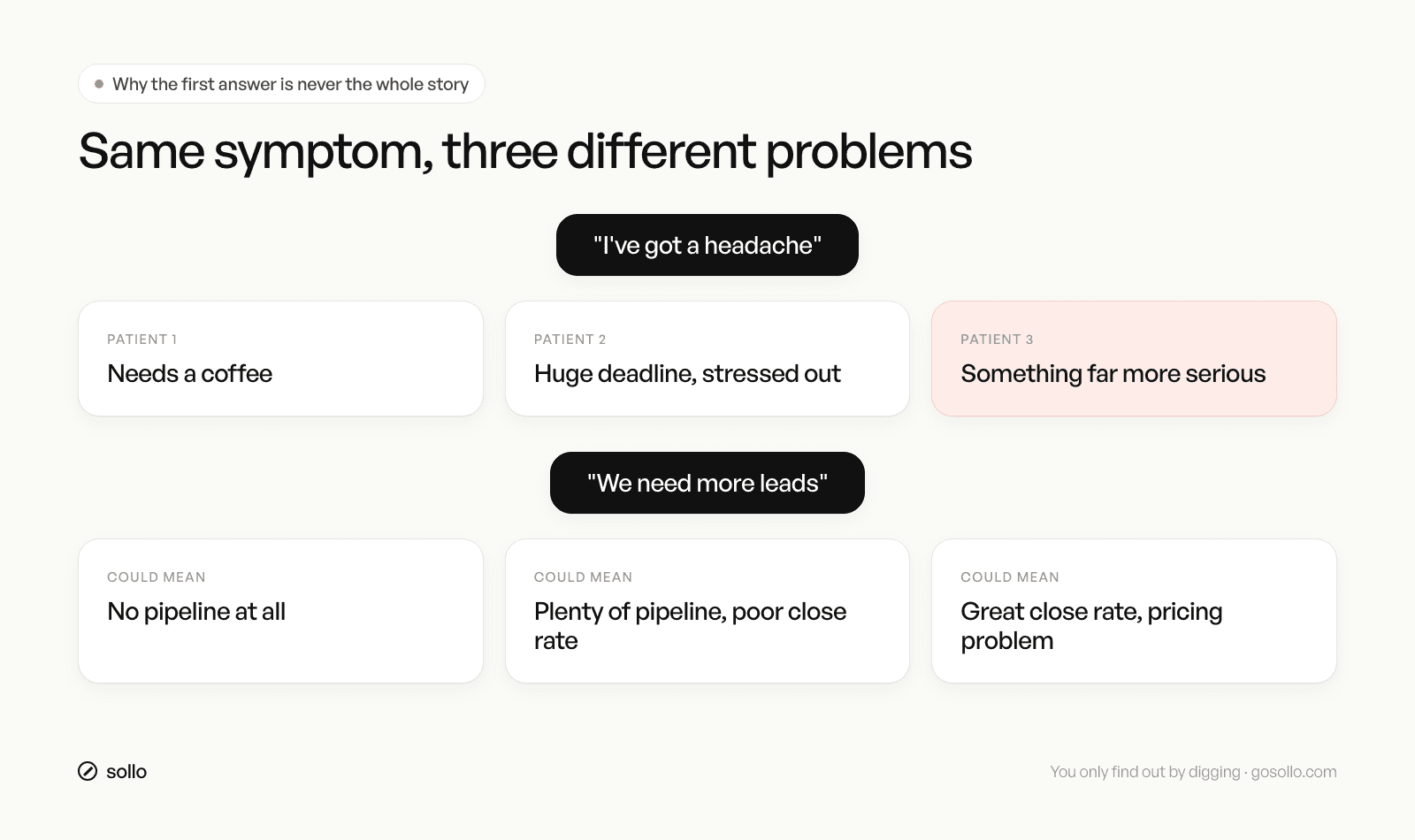
Your prospects work the same way. The words they use on the first call are rarely the real problem, and your job is to be the good doctor who keeps asking.
What is the PRIQ sales discovery framework?
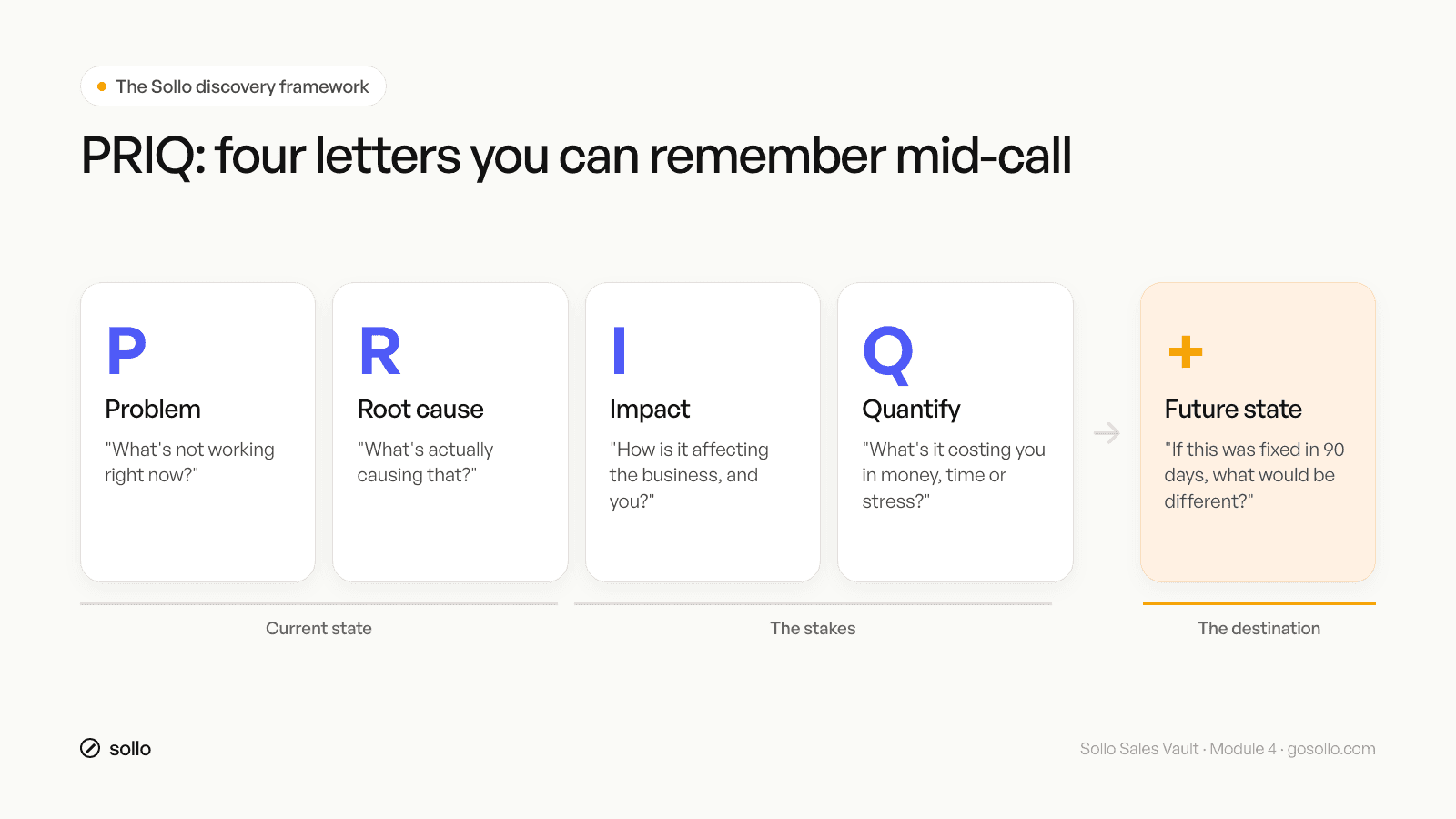
PRIQ is the Sollo sales discovery framework: Problem, Root cause, Impact and Quantify. You ask what's not working, what's causing it, how it affects the business and the person, and what it costs in money, time or stress. Finish with the future state and you've mapped the full gap.
It's four letters, which makes it easy to remember mid-call:
Problem: what's not working right now?
Root cause: what's actually causing that?
Impact: how is it affecting the business, and you personally?
Quantify: what's it costing you in money, time or stress?
After that you paint the future state. Problem and root cause give you the current state, impact and quantify tell you what's at stake, and the future state shows you where they want to end up. Put those together and you've got everything you need for the pitch and the proposal.
What are the best discovery call questions to ask?
The best discovery call questions are open and written in plain language. Start with facts about how they win clients today, then work through problem, root cause, impact, quantify, future state and the decision process. The 20 questions below cover every stage. Pick a few from each and put them in your own words.
Feel free to steal these, and once they start to feel natural, rephrase them so they sound like you.
Stage | Question | Listen for |
|---|---|---|
Facts | 1. "Walk me through how you win new clients today, from first contact to signed." | Where the process is manual, slow or leaky |
Facts | 2. "Who else is involved in that process?" | Other people who touch the deal or the decision |
Facts | 3. "What tools are you using at the moment?" | What they've already bought and what they're frustrated with |
Problem | 4. "What made you want to have this conversation now?" | The trigger event and the urgency behind it |
Problem | 5. "What's not working the way you'd like it to?" | Their words for the problem (write them down) |
Problem | 6. "If you could wave a magic wand and fix one thing, what would it be?" | Their top priority |
Root cause | 7. "What do you think is causing that?" | Whether their diagnosis matches yours |
Root cause | 8. "What have you already tried? What happened?" | Past failures, objections you'll face later |
Root cause | 9. "How long has this been going on?" | How entrenched the problem is |
Impact | 10. "How is that affecting the business?" | Revenue, growth, team and reputation effects |
Impact | 11. "And how is it affecting you personally?" | Stress, time, frustration (the emotional reason to buy) |
Impact | 12. "What happens if nothing changes over the next six months?" | The cost of doing nothing |
Quantify | 13. "Roughly what is that costing you each month?" | A number you can put in the proposal |
Quantify | 14. "How many hours a week go into dealing with it?" | Time cost |
Quantify | 15. "How many deals do you think you're losing because of it?" | Lost revenue |
Future state | 16. "If this was fixed 90 days from now, what would be different?" | Their picture of success |
Future state | 17. "What would that be worth to you?" | The value they put on the outcome |
Future state | 18. "Why is it important to fix this now rather than next year?" | Urgency, in their own words |
Decision | 19. "Who else needs to be involved in a decision like this?" | Every person who can say yes, or no |
Decision | 20. "How have you made decisions like this in the past?" | Their buying process and timeline |
You won't need all 20 on every call. Most of mine use six to ten, and the rest of the time goes on follow-ups. If you want these on one page, grab the printable question bank and discovery notes template in the free Sollo Sales Vault.
If you're wondering where these questions sit inside the whole call, from rapport to next steps, read my 7-step sales call structure.
How do you run a discovery call so people open up?
People open up when a discovery call feels like a conversation rather than an interrogation. Keep asking past the first answer, mirror their last few words, label the emotion you hear, ask "what" and "how" questions instead of yes or no ones, and get comfortable with silence after big questions.
A few simple habits make a big difference here, and most of them come from Chris Voss's Never Split the Difference.
Never accept the first answer
Follow up with "tell me more about that" or "what do you mean by that?" The useful detail almost always turns up in the second or third answer, because the first one is the headache and the third is usually closer to the diagnosis.
Mirror their last few words
If they say "we just can't keep up with follow-ups", you say:
"Can't keep up?"
Then wait. It feels odd the first time, but it works brilliantly, because people keep talking to fill the silence.
Label what you're hearing
"It sounds like this has been really frustrating."
Naming the emotion shows you're listening, and it usually opens them up even more.
Ask what and how questions
"What's getting in the way?" gets you a story, whereas "Is anything getting in the way?" gets you a yes or a no. Voss calls these calibrated questions, and the stories they draw out are where you'll find the gap.
Get comfortable with silence
After you ask a big question, count to five in your head before you say anything else. The answer that comes after the silence is usually the honest one.
How do you know if a prospect is actually a good fit?
A prospect is a good fit when you can answer yes to four questions by the end of discovery. Do they have a problem you can fix? Do they agree they have it? Do they want to fix it? Will they work with you to fix it? Four yeses means a real opportunity. Any no means stop chasing.
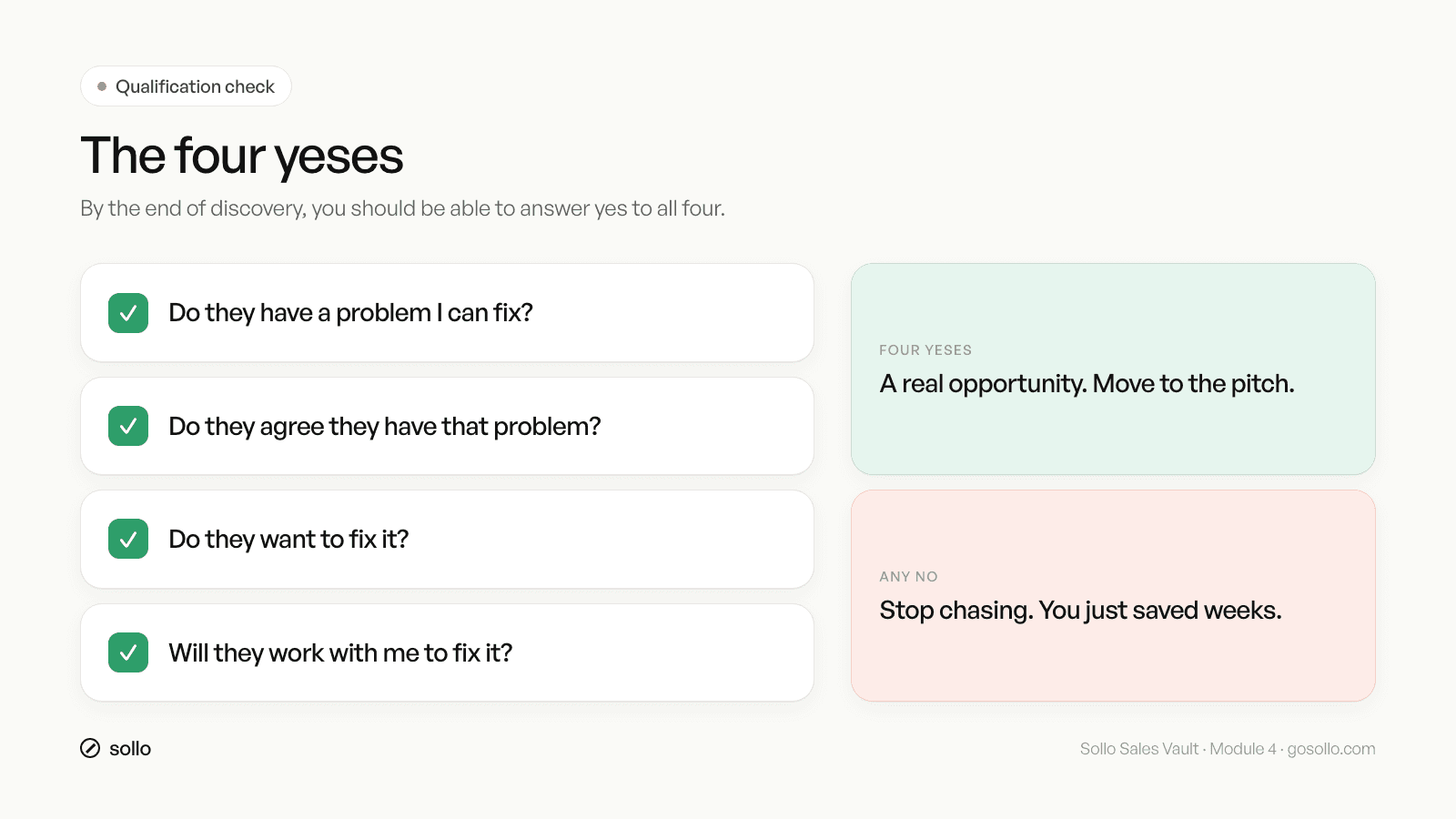
If any of them is a no, you've just saved yourself weeks of chasing a deal that was never going to close.
Solo consultants find this part the hardest, because when your pipeline is thin every lead feels precious. A "maybe" that drags on for weeks costs you more than a clean "no", though. Be honest on the call and you'll only need to follow up with the people who actually want to buy.
How do you close out a discovery call?
Close out a discovery call by summarising everything back to the prospect in their own words: their current state, the cost, and the future state they want. Then ask "Have I got that right?" When they say "that's right", you've earned the right to show them how you can help.
In practice it sounds something like this:
"So right now you're getting about 20 leads a month, only two are converting, and you think it's because nobody follows up after the first call. That's costing you roughly $15,000 a month in lost revenue, and you want to double your conversions by the end of the quarter. Have I got that right?"
Chris Voss treats "that's right" as a breakthrough moment, because it means the other person feels truly understood. "You're right" is usually just politeness, whereas "that's right" tells you they genuinely agree.
When you hear it, that's your bridge into the pitch. I cover what comes next in how to pitch your services, and the summary you just gave becomes the heart of your consulting proposal.
What are the most common discovery call mistakes?
The most common discovery call mistakes are interrogating instead of conversing, leading the witness with loaded questions, forgetting to write down the prospect's exact words, and assuming everyone has the same problem. Each one either shuts the prospect down or leaves you pitching a gap you never properly understood.
Interrogating. Discovery is a conversation. Share what you've seen with other clients as you go.
Leading the witness. "So your problem is leads, right?" tells them what to think. Let them tell you.
Forgetting to write it down. Their exact words become your proposal later.
Assuming everyone has the same problem. Two people in the same role at the same company can have very different gaps.
How do you put this into practice on your next call?
Pick six discovery questions from the bank, at least one from each PRIQ stage, and write them on a card. Use them on your next call. Afterwards, write the prospect's current state, future state and gap in one paragraph, then check it against the four yeses. Repeat for three calls and it becomes habit.
That one paragraph is worth its weight in gold, because it becomes the opening of your pitch, the "where you are now" page of your proposal and the reason your price will make sense. If you want the bigger picture of how discovery fits into a full pipeline, start with the 7-step sales system for solo consultants.
FAQ
How many discovery call questions should I ask?
Most good discovery calls use six to ten prepared questions, with the rest of the time spent on follow-ups like "tell me more about that". Aim for at least one question from each PRIQ stage plus one on the decision process. Going deep on a few questions will get you further than racing through all 20.
How long should a discovery call be?
Plan for 30 to 45 minutes, which is enough to work through problem, root cause, impact, quantify and future state without rushing. The prospect should do most of the talking. If you find yourself pitching in the first ten minutes, slow down and go back to your questions.
What is the difference between GAP Selling and PRIQ?
GAP Selling, from Keenan, is the idea that people buy the change from their current state to a future state. PRIQ is the Sollo question sequence for mapping that gap on a call: Problem, Root cause, Impact, Quantify, then future state. GAP explains why people buy, and PRIQ gives you the questions.
What if the prospect won't give me a number?
Make it easy with ranges or proxies, such as how many hours a week the problem takes or how many deals they think they've lost. You can also label it: "It sounds like that's hard to put a number on." A rough estimate from them is far more persuasive than a precise one from you.
Should I pitch on the discovery call?
Only once they've said "that's right" to your summary, because until then you don't know enough to pitch well. For bigger deals, book a separate call to present your recommendation, which gives you time to tailor the pitch and proposal to exactly what they told you.
How can Sollo help?
Discovery only pays off if you capture it. In Sollo you save your discovery notes against the lead, right next to your conversations on LinkedIn, email and WhatsApp, so nothing ends up on a sticky note or in a notebook you can't find.
When it's time to write the proposal, Sollo's AI sales agent builds it from those notes, so the proposal is written in their words. It can also prep you before the call and coach you on what to ask next.