
It has never been easier to start a consulting business, and yet almost everyone I talk to hits the same wall a few months in, which is finding leads.
You've got the skills, a decent offer and two or three clients who came through referrals. Then the referrals dry up, and you get that horrible feeling of not knowing where the next client is coming from (if you've ever googled how to find clients as a consultant at 11pm, you'll know exactly what I mean).
I've been there myself. After 10+ years in B2B sales, the one thing I'm sure of is that the solo consultants and fractional execs who never worry about leads have a system they run every day. It's a fairly boring system, and it works.
TL;DR: To find clients as a consultant without ads, write a four-line ideal client profile, then run three free channels: warm outreach to people who know you, relevant cold outreach to 5 new people a day, and LinkedIn content split into top, middle and bottom of funnel posts. Track contacts, conversations, calls and clients every Friday, and fix whichever number drops.
Who exactly should a consultant be looking for?
You should be looking for one clearly defined type of client, written down as a four-line ideal client profile (ICP): who it's for, who it's not for, what stage they're at, and what they're struggling with in their own words. Trying to sell to everyone makes your outreach and content sound generic, so nobody feels it was written for them.
Before you send a single message, write these four lines:
Who is this for? Role, type of business, size.
Who is it NOT for? Be just as specific here, because it saves you hours.
What stage are they at? Just started, stuck at a plateau, or scaling.
What are they struggling with? In their words, the way they'd say it to a mate at the pub rather than how you'd put it in a slide deck.
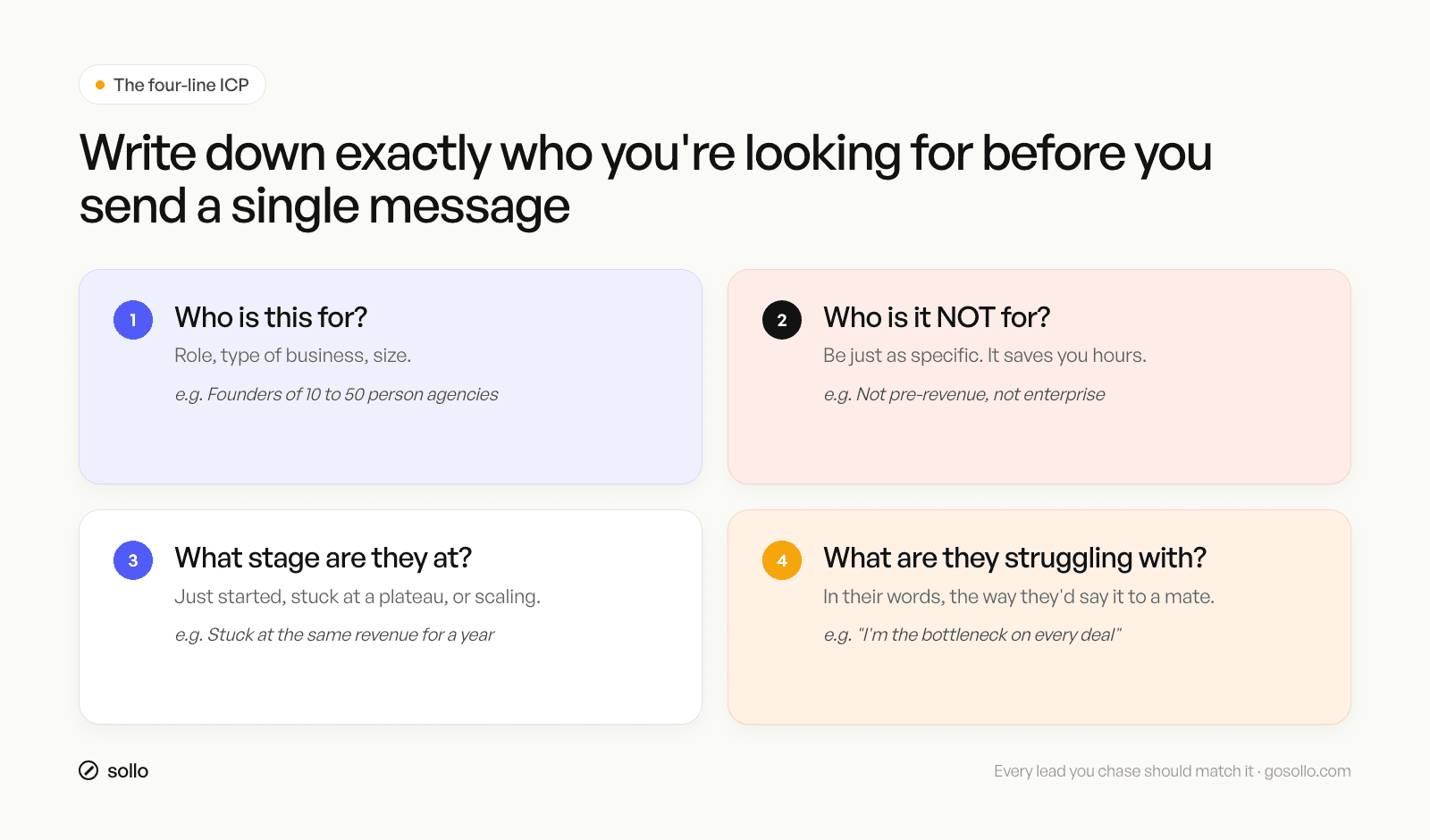
Keep it somewhere you can see it, and check that every lead you chase matches it. If your offer isn't sharp yet, fix that first with how to create an irresistible offer.
What are the four ways to find clients as a consultant?
There are only four ways to let people know you exist: warm outreach (one to one, people who know you), content (one to many, people who know you), cold outreach (one to one, people who don't) and paid ads (one to many, people who don't). Solo consultants should start with the first three and leave ads until later.
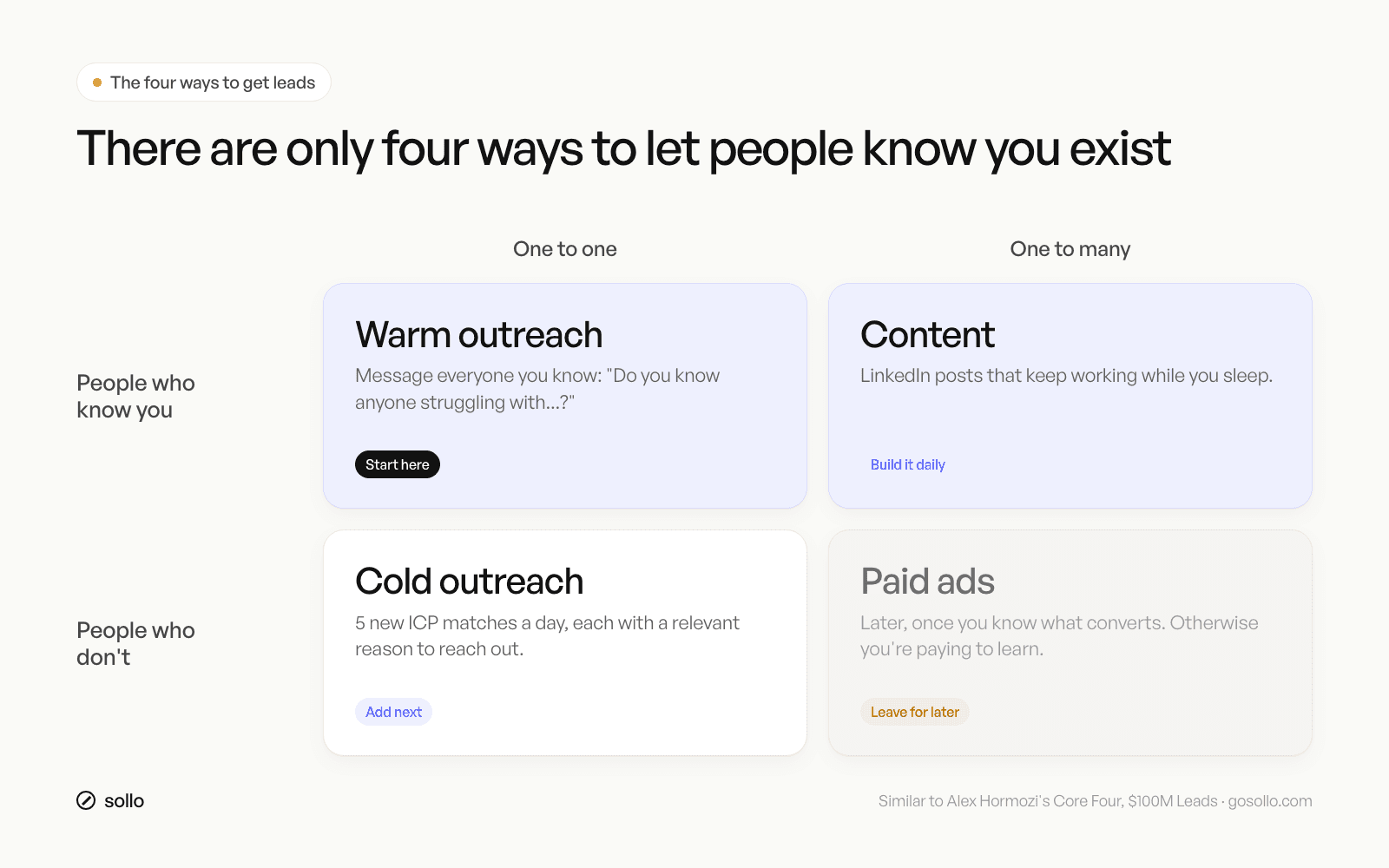
If this looks familiar, it's close to what Alex Hormozi calls the Core Four in $100M Leads. Leave ads until last because, until you know exactly what message converts, you're just paying to learn.
Step 1: Start with warm outreach
This is the fastest money in the room, and almost nobody does it properly.
Write a list of everyone you know: former colleagues, old clients, people from your last job, your mate who runs a gym. Then message each one personally (no copy-paste blast) and ask one simple question:
"Do you know anyone who's struggling with [the problem you solve]?"
They already know and trust you, so you skip the hardest part of selling. Aim for a list of 50 and message 10 of them today.
Step 2: Add relevant cold outreach
Cold outreach works when it's relevant. Find people who match your ICP, look for a reason to reach out (a post they wrote, a hire they made, a problem their industry is facing) and lead with that.
Keep the first message short and about them, and end with a question that's easy to answer, something like this:
"Saw you've just hired your first two account execs. Congrats. Curious, how are you handling onboarding them while you're still closing deals yourself?"
All you're doing at this stage is starting a conversation, so save the pitch for later.
Step 3: Build content that compounds
Content keeps working while you sleep, and done properly it can become your biggest source of clients. LinkedIn gets its own section below.
How much outreach is enough to find consistent, high-quality leads?
Reach out to 5 new people every day who match your ICP, each with a message written for them and relevant to what's going on in their world right now. That's 25 new people a week and over 100 a month, which is plenty of conversations for most solo consultants and fractional execs.
The people who burn out on outreach tend to be blasting 100 generic messages a day and getting ignored, whereas five thoughtful ones get replies and are easy to keep up alongside client work for months. Block 30 minutes a day and treat it like a client meeting.
Grab the ICP one-pager, outreach tracker and LinkedIn post planner in the free Sollo Sales Vault, which are the exact templates I use to run this.
Why don't prospects buy straight away?
Prospects hold off because trust takes time to build. A useful rule of thumb is 7-11-4: before most people buy, they need around 7 hours of interaction with you, 11 touchpoints and 4 different mediums (LinkedIn, email, a call, an event). So a first message with no reply is completely normal, and you shouldn't read it as rejection.
Your job is to keep showing up in different places until you've earned the conversation, whether that's content, a newsletter, a quick video message or a small event. It's also why following up with prospects matters so much.
How do you get clients on LinkedIn without paying for ads?
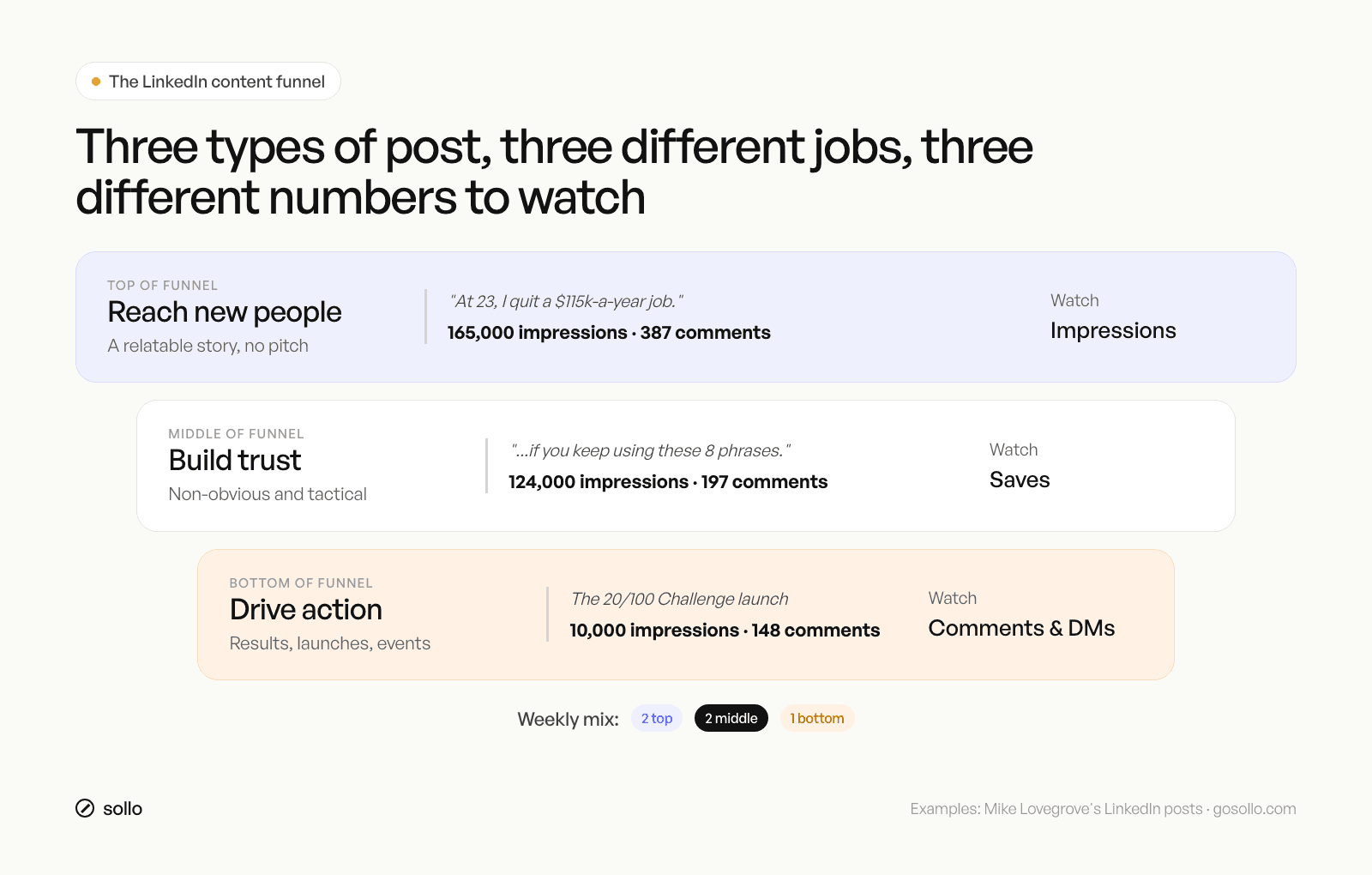
Post three types of content on purpose: top of funnel stories to reach new people, middle of funnel tactical posts to build trust, and bottom of funnel posts about results or launches to drive action. Judge each on its own metric, post around five times a week, and message the people who engage.
A little while ago I posted two things on LinkedIn, four days apart. One was a personal story that got 165,000 impressions, and the other was the launch of the 20/100 Challenge (the thing I actually wanted people to sign up for), which got 10,000.
A year ago that would have stung, but now I think it's perfect, because both posts did exactly the job they were built for. Most people write one type of post on repeat, then wonder why they get loads of eyeballs and no clients, or clients and nobody watching.
The one rule for every post: write for a 10% brain
People scrolling LinkedIn are running at about 10% mental capacity. They're on the loo, in a queue, half watching Netflix, or killing 90 seconds before their next call, and nobody is leaning in waiting to absorb your genius.
So every post has to work for a tired brain, which means short lines, plain words and one idea per post.
Top of funnel: relatable, and it tells a story
This post brings new people in, so the job is reach and the metric is impressions. It has to be about something lots of people have felt, told in a way that makes them go "yep, that's me".
Stories do this best, because a story asks nothing of a 10% brain. One of mine opened with "At 23, I quit a $115k-a-year job. My mates thought I was insane." and simply told the story of walking away from a safe salary and what happened next. It got 165,000 impressions and 387 comments, and I left the pitch out on purpose.
Middle of funnel: non-obvious and highly tactical
This post turns "who's this person?" into "this person knows what they're talking about". The job is trust and the metric is saves, because a save means "I want this when I'm actually working", which is a future client bookmarking you.
Advice like "be consistent" is too obvious to save, while "Stop saying these 8 phrases on your sales calls" is non-obvious and tactical, and that post of mine got 124,000 impressions, 728 reactions and 197 comments. My most-saved sales post, on how badly most people introduce themselves, got 1,827 saves.
It's also worth turning what you know into your own named framework and giving it away. Information is freely available anyway, and what people pay for is your insight and how you'd implement it for them.
Bottom of funnel: results, or something new you're launching
This post is for people who already know you, so the job is action and the metric is comments and DMs. Talk about outcomes, a new offer or an event, the kind of thing that bores a stranger and delights a warm reader.
Reach will be way lower, and that's fine. My 20/100 Challenge launch got 10,000 impressions and 148 comments, and our first Sollo event in Amsterdam got 4,000 impressions and 133 comments. Compare the comment-to-impression ratio with the 165k post and you can see what bottom of funnel looks like when it's working.
The weekly mix: 2, 2, 1
A good rhythm to start with is five posts a week:
2 top of funnel to keep new people coming in
2 middle of funnel to build trust with the people who arrived
1 bottom of funnel to give the warm ones something to act on
Run it for a month, then adjust based on which posts led to conversations.
Where to find things to write about
You're probably already sitting on plenty of material, and I go to three places for it every week:
Customer transcripts. The exact words clients use for their problem become your topics.
What people ask you. If several people asked you directly, plenty more are thinking it.
Reddit. Try r/consulting, r/freelance or r/smallbusiness. Threads with 200 comments tell you what to write next.
Turning attention into conversations
Posting builds attention, and turning that into conversations comes down to three habits: reply to every comment (especially on bottom of funnel posts), add people who comment on or save your posts to your 5 new people a day, and always give warm readers a next step, like an event, a challenge or a call.
How do you know your lead generation is working?
Track four numbers every Friday: contacts (new people you reached), conversations (people who replied), calls (discovery calls booked) and clients (deals closed). When one number drops, you know exactly where to look, so you can stop guessing and fix the one part of the system that's actually broken.
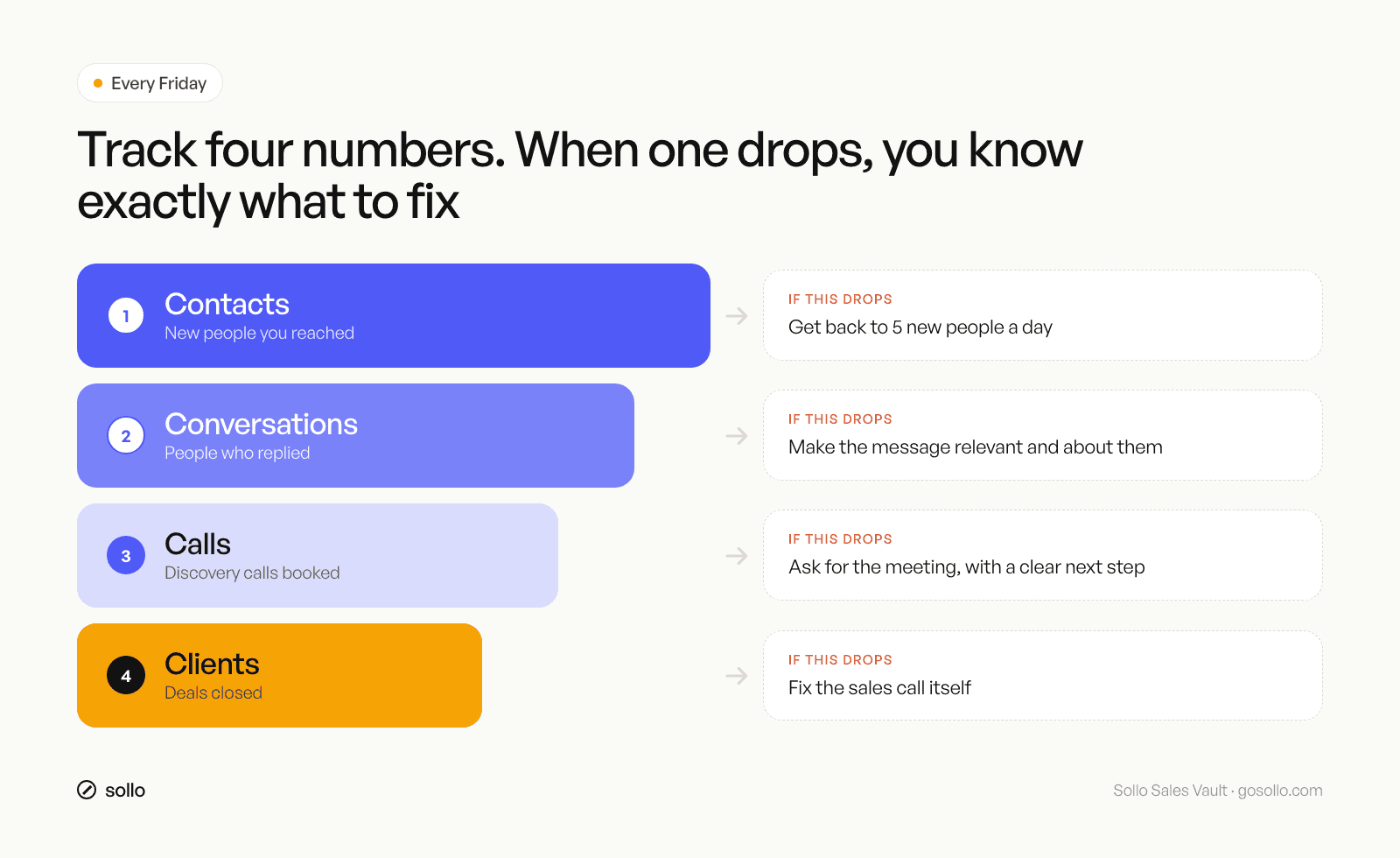
If contacts are low, you skipped your 5 a day, and if replies are low, the message needs to be more relevant. Replies with no calls means you need to ask for the meeting, while calls with no clients point to the call itself, so read the 7-step sales call run order.
For how leads fit the rest of your process, see the 7-step sales system for solo consultants.
What mistakes stop consultants finding clients?
The big ones are relying on referrals alone, sending generic messages, pitching in the first message, posting only for reach, and giving up after two weeks. Each one feels reasonable in the moment, but together they explain why most consultants have a feast-and-famine pipeline instead of a steady flow of good leads.
Relying on referrals alone. They're amazing until they stop, and they always seem to stop at the worst time.
Spraying generic messages. If it could be sent to anyone, it'll be ignored by everyone.
Pitching in the first message. Earn the conversation first.
Posting only for reach. Big numbers feel great and pay nothing on their own.
Giving up after two weeks. Five a day compounds, but only if you keep going for months.
What should you do this week to find more clients?
Write your four-line ICP, message 10 people you already know, block 30 minutes a day for 5 new relevant contacts, plan five LinkedIn posts in a 2/2/1 mix, and set up your Friday numbers. None of it costs a cent, and it all compounds as long as you keep it running.
Label your last 10 LinkedIn posts top, middle or bottom of funnel, then plan next week: 2, 2, 1.
Name one framework you use with clients and give it away in a middle of funnel post.
Message 5 people who engaged with your posts this week.
FAQ
How do fractional executives find consistent, high-quality leads?
The same way solo consultants do: a tight ICP, warm outreach to their existing network (which is usually large after years in senior roles), 5 relevant cold messages a day, and LinkedIn content that shows how they think. The consistency comes from running it daily and reviewing four numbers every Friday.
What are the best lead generation tools for solopreneurs?
The tool matters less than the system. You need somewhere to find people who match your ICP, one place to hold conversations across LinkedIn and email, and reminders so follow-ups don't slip. Many solopreneurs start with a spreadsheet, and when that gets messy, a simple CRM built for one person helps.
Is cold outreach still worth it for consultants?
Yes, as long as it's relevant. Generic, pitchy messages get ignored, but cold outreach works well when you pick people who match your ICP, reference something real in their world, keep the message short and end with an easy question. Five of those a day will beat a hundred templated messages.
How many LinkedIn posts a week should a consultant publish?
Start with five: two top of funnel stories for reach, two middle of funnel tactical posts for trust, and one bottom of funnel post about results or a launch for action. Run it for a month, check which posts started real conversations, then adjust the mix based on what actually led to calls.
How long does it take to see results from outreach?
Warm outreach can produce conversations within days, because trust already exists. Cold outreach and content take longer, since most people need many touchpoints before they buy (the 7-11-4 rule of thumb). Expect it to compound over months, which is why giving up after two weeks is the most common mistake.
How can Sollo help?
Sollo is the sales platform built for one-person businesses. Find leads matching your ICP from a database of 380M people verified across 20 data sources, message them over LinkedIn, email and WhatsApp from one inbox, and get reminded who to follow up with, so your 5 a day runs from one place instead of five tabs and a spreadsheet.
The people your posts attract land in your pipeline too, and the AI sales agent drafts relevant first messages for you to edit and send. As Leo, a go-to-market consultant in Bulgaria, put it: "Building a prospect list and communicating over three channels, in one place. That's amazing."