
In 1997, Apple was close to going bankrupt. Steve Jobs came back, and one of the first things he did was tell the company to stop talking about processor speeds and megabytes.
Customers didn't care about any of that. What they cared about was what an Apple could help them do, and who they could be by using one.
Most of the pitches I see from solopreneurs are still stuck in the megabytes: here's what I do, here's my process, here are my packages, here's my price. Meanwhile the prospect sits there politely, trying to work out why any of it matters to them.
If you want to know how to pitch your services so people actually want to buy, the best pitches feel like a diagnosis. You help the buyer understand their options, show them what good looks like, and by the time you talk about yourself, you're the obvious answer.
TL;DR: To pitch your services well, talk about the buyer's world before yours. Use April Dunford's 8-step structure: insight, alternatives, perfect world, then introduction, differentiated value, proof, objections and a clear ask. Keep the setup to five to ten minutes, spend most of your time on value, and always end by prescribing one specific next step.
Why is buying so hard for your prospect?
Buying is hard because your prospect is busy, has probably never bought something like this before, and is scared of getting it wrong. Every option claims to be the best, so the safest move is to do nothing, and between 40% and 60% of buying processes end exactly that way, with no decision at all.
We spend so much time worrying about how hard selling is that we forget buying is often harder.
Think about it from their side. They've looked at five other options, they all say roughly the same things, and there's no easy way to compare them. If they pick wrong, it's their money, their time and their reputation on the line, so the safest thing they can do is stick with what they've got.
Matthew Dixon and Ted McKenna found this in The JOLT Effect: somewhere between 40% and 60% of buying processes end with no decision. Your biggest competitor is usually the status quo rather than another consultant.
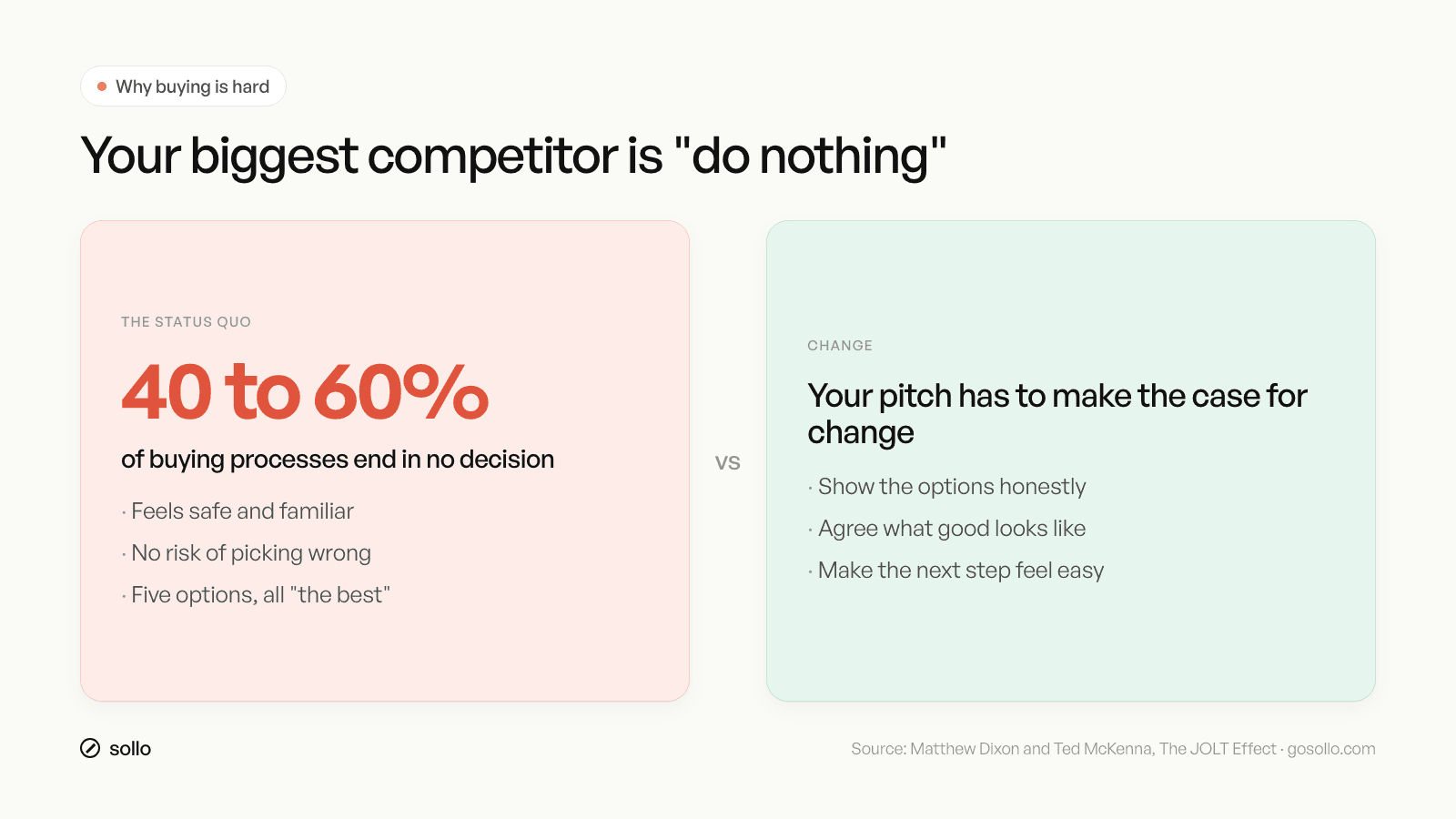
That changes the job of your pitch. Proving you're better than the next person matters far less than making the case for change and making that change feel safe.
What is the best sales pitch structure?
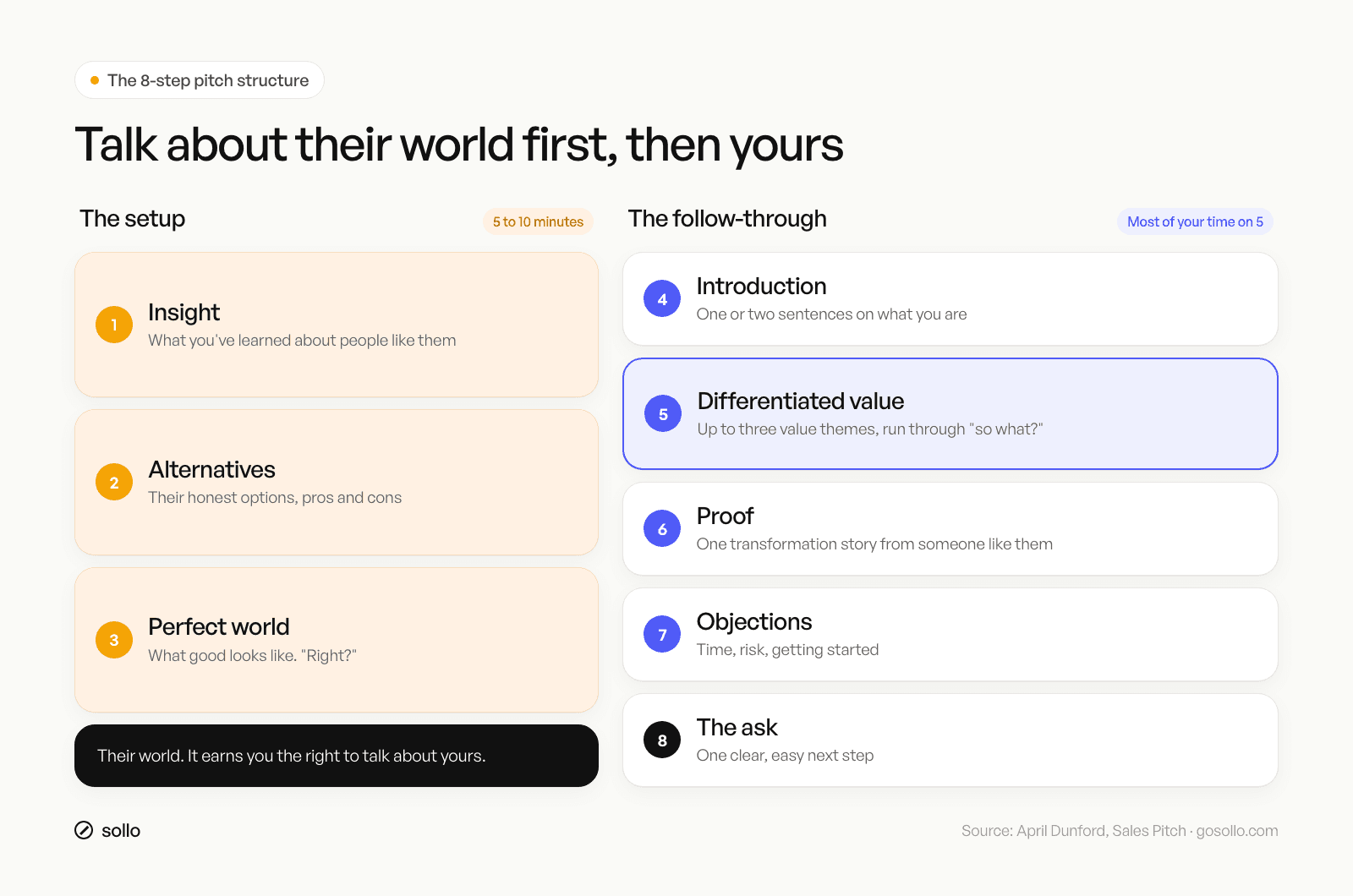
The best sales pitch structure I've found is April Dunford's 8-step pitch from her book Sales Pitch. It has two halves. The setup (insight, alternatives, perfect world) is about the buyer's world. The follow-through (introduction, differentiated value, proof, objections, the ask) is about yours. The setup earns the right to the follow-through.
This is the order at a glance:
Insight: something you've learned about people like them.
Alternatives: the honest options they have, with pros and cons.
The perfect world: what an ideal solution would look like.
Introduction: one or two sentences on what you are.
Differentiated value: up to three value themes, and how you deliver each.
Proof: a transformation story from someone like them.
Objections: the ones you know are coming.
The ask: one clear, easy next step.
To make it concrete, I'll show you how I'd pitch Sollo at each step, and you can swap in your own service as you read.
Step 1: Insight
Open with something you've learned about people like them. It should point straight at the value only you can deliver.
"Most of the solopreneurs we work with have plenty of skill and a decent offer. Where they struggle is keeping a steady flow of leads coming in while they're busy delivering for clients."
Keep it to a minute or two, because all you're doing here is framing the conversation (nobody booked the call for a keynote).
Step 2: Alternatives
Walk through the options they have, honestly, with the pros and cons of each. This is where you do a lot of your discovery, so ask questions as you go.
"When people hit this, they usually do one of three things. They cobble together LinkedIn Premium, a spreadsheet and a couple of other tools. Or they buy a big CRM that was built for sales teams of 50. Or they just rely on referrals and hope. How are you handling it at the moment?"
You're giving them a map of the market, which is exactly what a confused buyer needs, and being fair here builds trust you'll cash in later.
Step 3: The perfect world
Describe what an ideal solution would look like for someone like them, pulling the best bits of each alternative and dropping the worst.
"So in a perfect world you'd have something as simple as a spreadsheet, that actually finds leads for you, and keeps every conversation and follow-up in one place, without the cost and complexity of a team CRM. Right?"
That "right?" is the turning point of the whole pitch. If they agree, they've just signed up to buying criteria that you meet. If they don't, they're probably not a fit, and it's good to know that now.
Step 4: Introduction
Give them one or two sentences on what you are, and leave it there.
"That's exactly why we built Sollo. It's a lead generation CRM built for solopreneurs."
Notice how late this comes. Most people open with it, but by the time you get here in this structure, the prospect already wants to know what you are.
Step 5: Differentiated value
This is the meat of the pitch and where you spend most of your time. Pick a maximum of three value themes, and for each one, show how you deliver it. Only show what connects to the problems they told you about in discovery.
Step 6: Proof
Show that you can do what you say. The best proof is a transformation story from someone just like them: where they were, what changed, where they are now, and how long it took.
My own story shows the shape. When I founded JRNY in 2016, I had a product background and zero sales experience. Year one, we did $30k ARR and nearly failed, and I was off salary, living on savings. So I committed to learning sales properly, and six months later we were at $500k ARR.
That covers where I was, what changed, where I ended up and how long it took. One detailed, relevant story like that will do more for you than a whole wall of client logos.
Step 7: Objections
Handle the ones you know are coming, even if they haven't said them out loud. For most solopreneurs buying from you, that's:
Time: "I don't have time to learn a new tool."
Risk: "What if it doesn't work for me?"
Getting started: "This sounds like a big setup."
Name them before they do. It shows you understand their world, and it takes the air out of the objection before it has a chance to grow. If price comes up, I've written a full guide on how to handle price objections.
Step 8: The ask
Finish by prescribing one clear, easy next step. You're the guide here, and guides don't end with "so, what do you think?"
"Here's what I'd recommend. Let's get you set up on a trial today, and we'll jump on a 20 minute call next week to check the first leads it's found for you."
How do you turn features into benefits in a pitch?
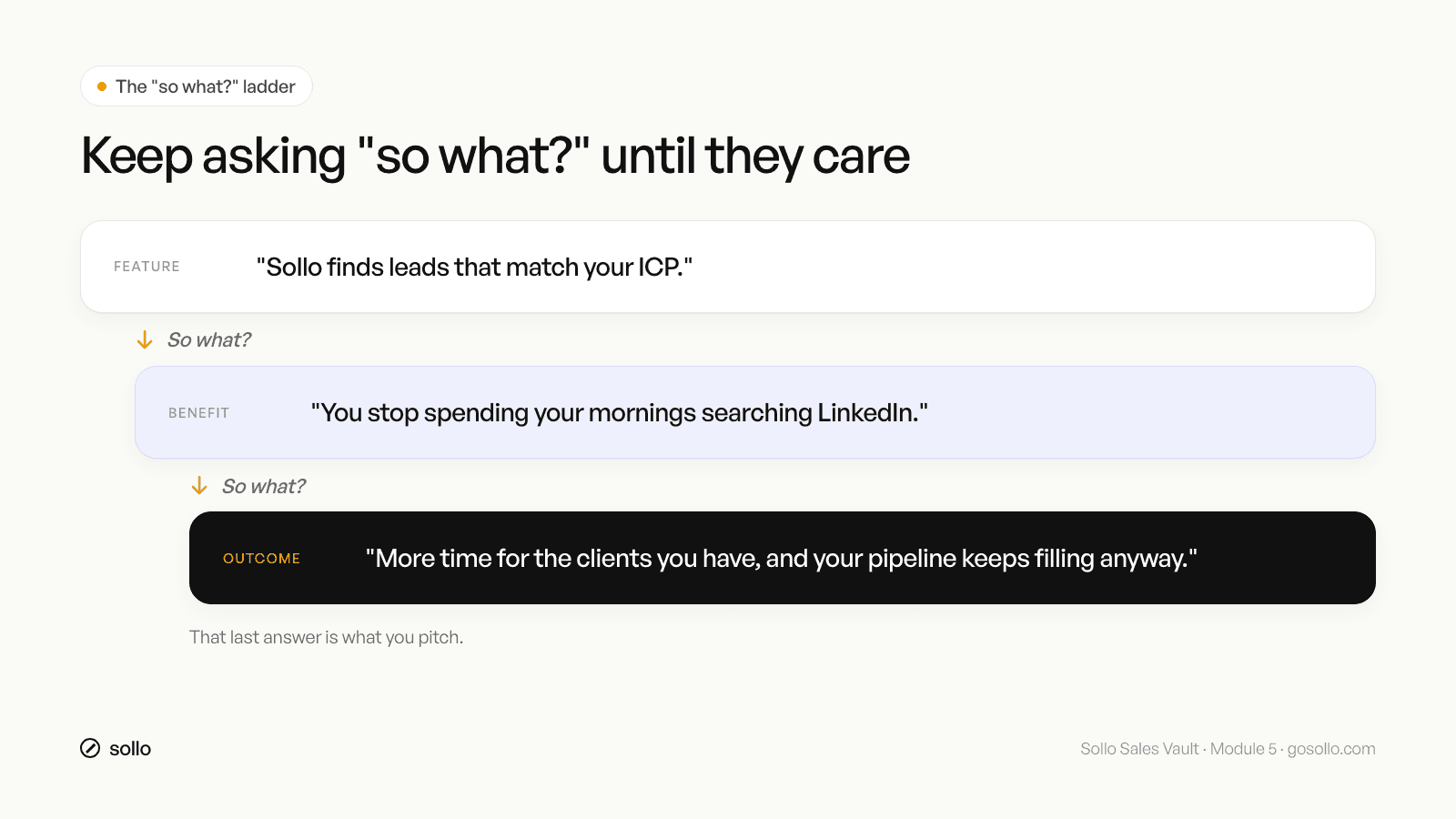
Turn features into benefits by asking "so what?" after every feature until you reach something the buyer genuinely cares about. The first answer is usually a benefit. The second or third is the outcome, meaning the change in their business or life. Pitch the outcome, and use the feature only as proof you can deliver it.
For every feature, keep asking yourself "so what?" until you get there. This is how it works for Sollo:
Feature: "Sollo finds leads that match your ICP." So what?
Benefit: "So you stop spending your mornings searching LinkedIn." So what?
Outcome: "So you've got more time to deliver for the clients you already have, and your pipeline keeps filling up anyway."
That last answer is the one you pitch.
Run each of your three value themes through the ladder at least twice. If you can't get past the benefit, the theme probably isn't strong enough to make the cut.
How long should each part of a sales pitch take?
Keep the setup (insight, alternatives and perfect world) to around five to ten minutes. It's essential and you should never skip it, but it exists to set up your value. Spend the bulk of your time on Step 5, differentiated value, then move briskly through proof, objections and the ask.
If you spend half the call on the market, you'll lose them before the good bit, and if you skip the setup, your value has nothing to land on. Somewhere between five and ten minutes is about right.
A pitch usually follows discovery, sometimes on the same call and sometimes as a second meeting. If you want to see where it sits in the full run order, read my 7-step sales call structure.
If you'd like to plan yours before your next call, grab the 8-box pitch storyboard template in the free Sollo Sales Vault.
What are the biggest sales pitch mistakes?
The biggest sales pitch mistakes are starting with your company history, using a generic trend as your insight, showing every feature, bad-mouthing the alternatives, and ending with "let me know what you think". Each one either makes the pitch about you, loses the buyer's trust, or leaves them without a clear next step.
Starting with your company history. Nobody cares about your history until they can see you understand their world, so start there.
Using a generic trend as your insight. "AI is changing everything" is true for everyone, so it sets up nobody's value.
Showing every feature. Only show what connects to their problem.
Bad-mouthing the alternatives. Be fair about the other options, because the moment you exaggerate you lose their trust.
Ending with "let me know what you think". Tell them what happens next.
How do you build your own pitch?
Build your own pitch by storyboarding it in eight boxes, one per step: your insight, three alternatives with a pro and con each, your perfect world, a one-line introduction, three value themes run through "so what?", one matched transformation story, your top three unspoken objections, and your standard next step. Then practise it out loud.
Grab a blank page and fill in:
Your insight in one sentence.
Three alternatives, with a pro and a con for each.
Your perfect world in three bullet points.
Your one-line introduction.
Three value themes, each run through "so what?" at least twice.
One matched transformation story.
Your top three unspoken objections and your answer to each.
Your standard next step.
Then practise it out loud three times before your next call. It'll feel clunky the first time, but by the third run it'll start to sound like you.
Once they say yes to the next step, the pitch needs to become a document, and that's the job of a consulting proposal that gets signed.
FAQ
What is April Dunford's sales pitch framework?
April Dunford's framework, from her book Sales Pitch, is an 8-step structure: insight, alternatives, perfect world, introduction, differentiated value, proof, objections and the ask. The first three steps set up the buyer's world and buying criteria. The last five show how you deliver against those criteria and prescribe the next step.
How do I pitch my consulting services without sounding salesy?
Talk about their world before yours. Open with an insight about people like them, walk through their options honestly, and agree on what good looks like before you introduce yourself. When the pitch feels more like a diagnosis than a presentation, the prospect hears you as someone trying to help them decide.
How long should a sales pitch be?
There's no fixed length, but keep the setup to around five to ten minutes and spend most of the remaining time on differentiated value. Proof, objections and the ask should move quickly. If you're running out of time before the ask, cut some features and make sure you still agree the next step.
What should I say at the end of a pitch?
Prescribe one specific, easy next step, like a start date, a trial or a short follow-up call. Say it as a recommendation: "Here's what I'd recommend." Avoid "let me know what you think", which hands the buyer a decision they don't know how to make and invites no decision at all.
What if the prospect disagrees with my perfect world?
Treat it as useful information. Ask what they'd change, and listen. Either you've misread their priorities and can adjust, or they want something you don't offer, which means they're probably not a fit. Finding that out in minute eight is far better than after weeks of follow-up.
How can Sollo help?
A great pitch is built from what the prospect told you. In Sollo, everything they said in discovery is saved on their record, so you can build your insight and perfect world using their own words instead of guessing.
Sollo's AI sales agent can prep you before the call and coach you on what to say next, and your offers live in Sollo so your pitch and your proposal stay consistent.