
Early in my career, every objection gave me anxiety. The second a prospect said "that's a bit expensive", I'd panic, and then I'd drop the price, throw in extras, or start justifying every line of the proposal until I'd talked myself into a corner.
If you're a consultant, coach or fractional exec, you've probably felt the same thing. You've had a great call and sent a proposal you're proud of, and then one sentence knocks the wind out of you. Learning how to handle price objections is the difference between a business that holds its rates and one that slowly discounts itself into burnout.
Prospects will push if you let them, and most of the time they're only doing what anyone would do, which is testing whether the price is real.
Good negotiation means staying calm, understanding what's actually behind the pushback, and only giving something when you get something back. It's a skill like any other, which means you can learn it.
TL;DR: To handle price objections, hold your price. Find out which of four things is behind the pushback (value, risk, another decision maker, or deal-checking) by asking questions before you concede anything. Prepare a one-sheet before the call, use Chris Voss's tactics from Never Split the Difference, and only give on price when you get something back.
What does "it's too expensive" actually mean?
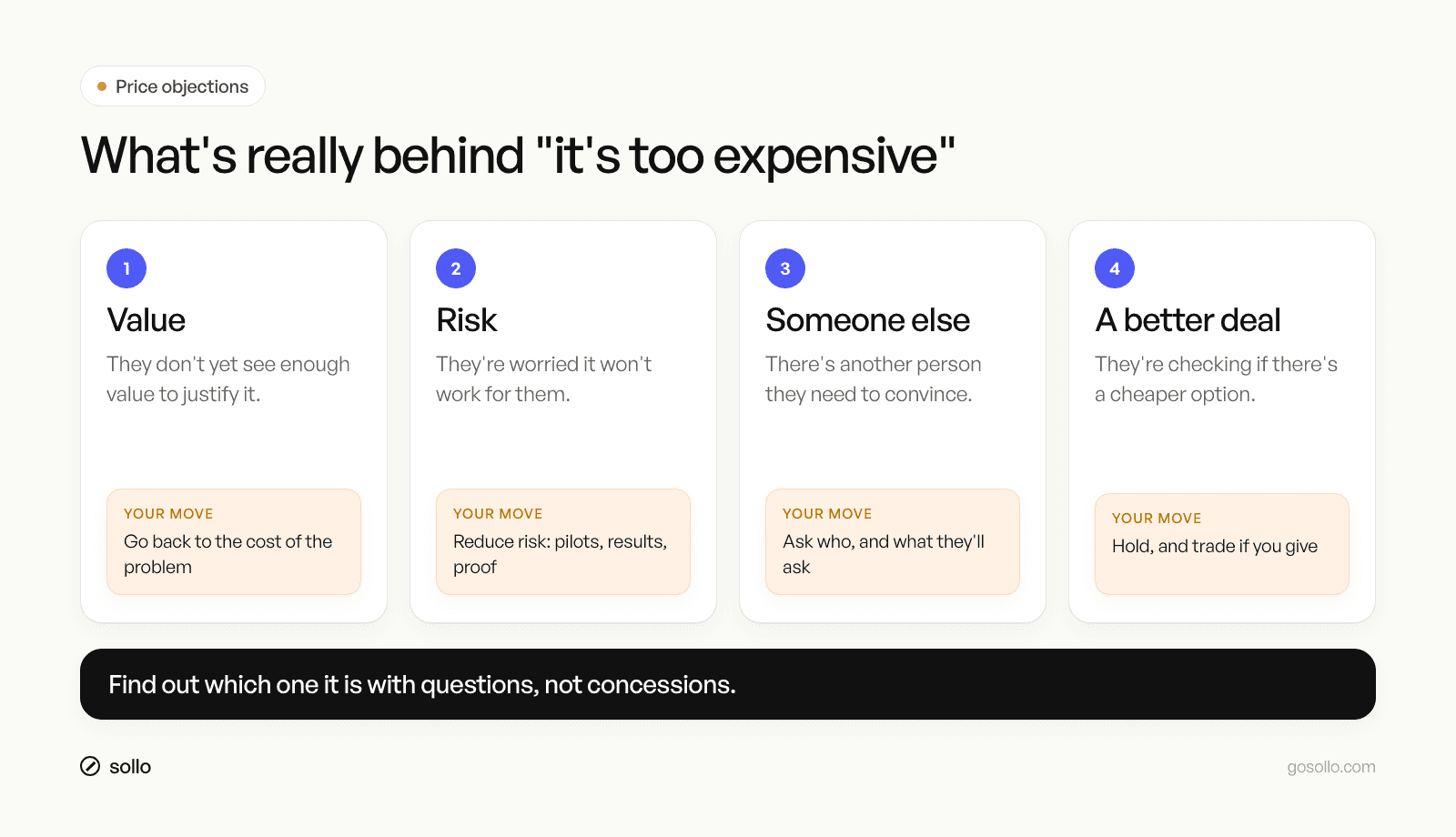
"It's too expensive" rarely means the prospect can't afford you. It usually means one of four things: they don't see enough value yet, they're worried it won't work, someone else needs convincing, or they're checking whether a better deal exists. Your job is to find out which one, and you do that by asking questions.
Each of these needs a different fix, so it's worth understanding them properly.
They don't yet see enough value. The price looks big because the problem looks small. Usually this means discovery didn't go deep enough, or you never put a number on the cost of the problem.
They're worried about the risk. They believe the result would be worth it, they just don't believe it'll happen for them, and price is the easiest thing to say out loud.
Someone else is involved. A business partner, a finance person, a spouse. Your prospect is rehearsing the objection they expect to hear from that person.
They're checking for a better deal. Some people ask for a discount on everything out of habit, so it says very little about your offer.
If you discount in response to any of the first three, all you've done is make yourself cheaper while the real doubt stays exactly where it was.
How do you prepare for a negotiation?
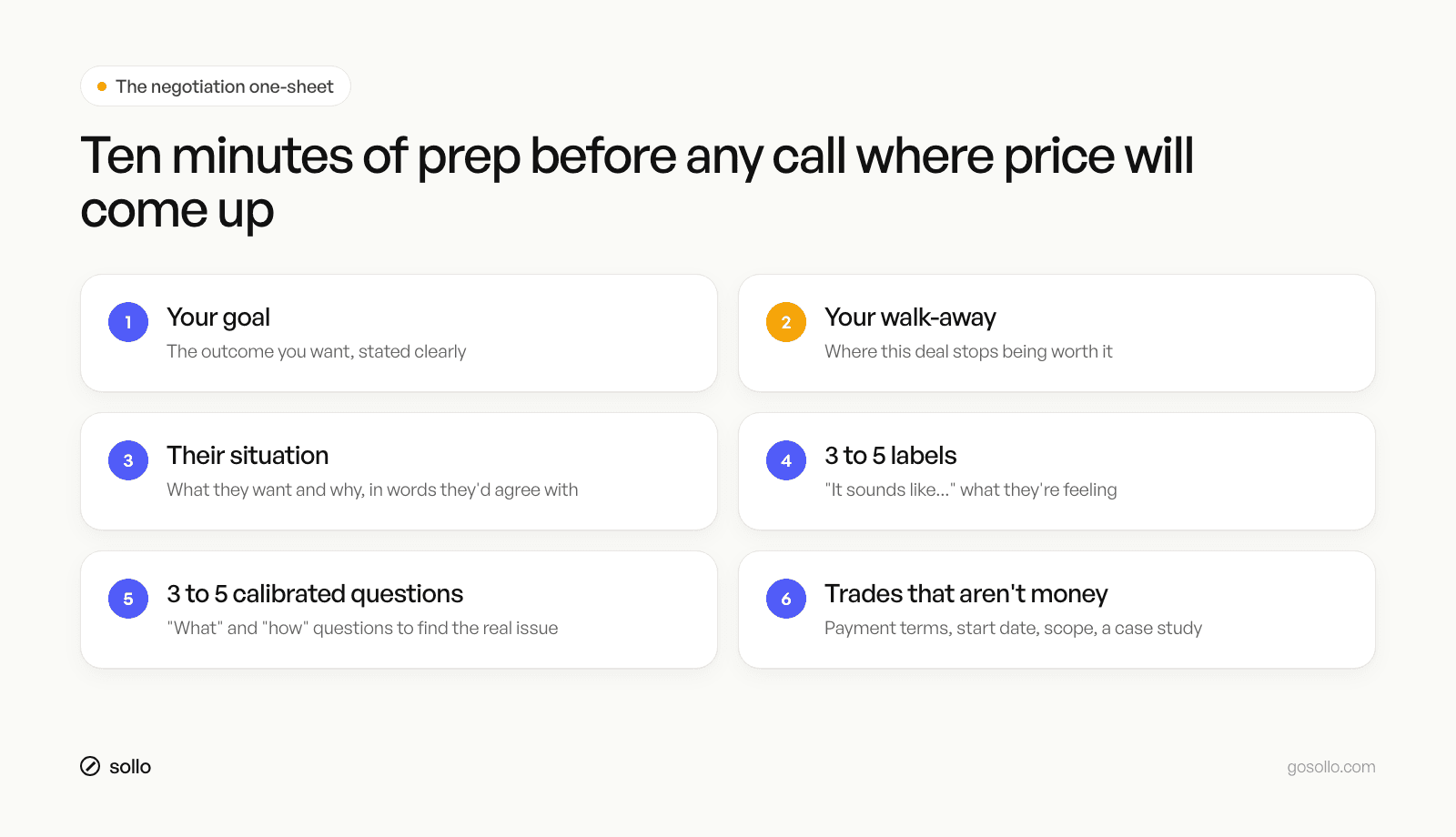
Prepare for a negotiation by filling in a one-sheet before any call where price is likely to come up. Write down your goal, your walk-away point, a summary of their situation, three to five labels, three to five calibrated questions, and the things you could trade that aren't money. Ten minutes of prep changes the whole conversation.
This is what goes on the one-sheet:
Your goal. The outcome you want, stated clearly. "Signed at the full fee, starting 1 March."
Your walk-away. The point where this deal stops being worth it. Decide this before the call, while you're calm, rather than in the middle of it.
A summary of the situation. What they want and why, written in a way they'd agree with.
Three to five labels. The things they're probably feeling. More on these below.
Three to five calibrated questions. To uncover what's really going on.
Things you could trade that aren't money. Payment terms, start dates, scope, a case study.
The walk-away is the bit most people skip, and I'd urge you not to, because knowing your floor is what stops you panicking when the pressure comes.
If you want this as a fill-in template, grab the negotiation one-sheet and objection script cards in the free Sollo Sales Vault.
What are the best sales negotiation tactics for consultants?
The five sales negotiation tactics that work best for consultants come from Chris Voss's book Never Split the Difference: run an accusation audit, label what they're feeling, mirror their words, ask calibrated "what" and "how" questions, and summarise until they say "that's right". Together they uncover the real objection without you conceding anything.
Voss was an FBI hostage negotiator, and his whole argument is that negotiation starts with emotion and only then gets logical, because people need to feel understood before they'll move. That works just as well on a $5,000 consulting proposal as it does in a crisis.

Tactic 1: Run an accusation audit
Say the negative stuff before they do. It takes the sting out and shows you understand their position.
"You're probably thinking this is a lot of money for where your business is right now, and you might be wondering whether it'll work for you."
It feels backwards the first time you do it, and then you watch the tension drain out of the conversation. Write yours before the call in three sentences, covering the worst things they might be thinking.
Tactic 2: Label what they're feeling
Name the emotion you're picking up on, then stop talking.
"It sounds like budget is the main worry here."
"It seems like you've been burned by something like this before."
Labels start with "it sounds like" or "it seems like", which keeps them about what you're noticing and gives the other person room to correct you or tell you more. Either way, you learn something useful.
Tactic 3: Mirror their words
Repeat the last one to three words they said, as a question, and wait.
Prospect: "We just don't have the budget this quarter."
You: "This quarter?"
Nine times out of ten they'll fill the silence with the real story. It might be that next quarter's fine, or that it's a cash flow thing, or that their business partner hasn't agreed yet, and whichever it is, you now know what you're actually dealing with.
Tactic 4: Ask calibrated questions
These are open questions that start with "what" or "how". They get the other person thinking about your problem and working to solve it with you.
"What would need to be true for this to work for you?"
"How would you like to move forward?"
"What's the biggest thing holding you back?"
"How am I supposed to do that?" (brilliant when they ask for a big discount)
Steer clear of "why" questions. "Why do you think it's too expensive?" sounds like an accusation, and people get defensive.
Tactic 5: Get to "that's right"
Summarise their position back to them until they say "that's right". When they do, they feel understood, and people who feel understood are far more willing to find a way forward.
Do listen out for "you're right", though, because that's usually a polite way of saying "please stop talking". "That's right" means they agree with your summary, whereas "you're right" means they'd like the conversation to end.
How do you negotiate without discounting?
To negotiate without discounting, never give anything for nothing. Every time a prospect asks for a lower price, less upfront, a trial or extra work, ask for something back: reduced scope, a longer commitment, payment in full, a clear yes on agreed results, or a case study. Trading protects your price and keeps your first number credible.
Every time you lower the price without getting something back, you teach them your first number wasn't real, and if that wasn't real, they'll start wondering what else in the proposal isn't.
So trade instead, and decide your trades before the call so you're never making them up under pressure.
If they want | You ask for |
|---|---|
A lower price | Reduced scope, or a longer commitment |
To pay less upfront | A longer contract term |
A discount | Payment in full upfront |
A trial or pilot | A clear yes if it hits agreed results |
Extra work thrown in | A case study or referral |
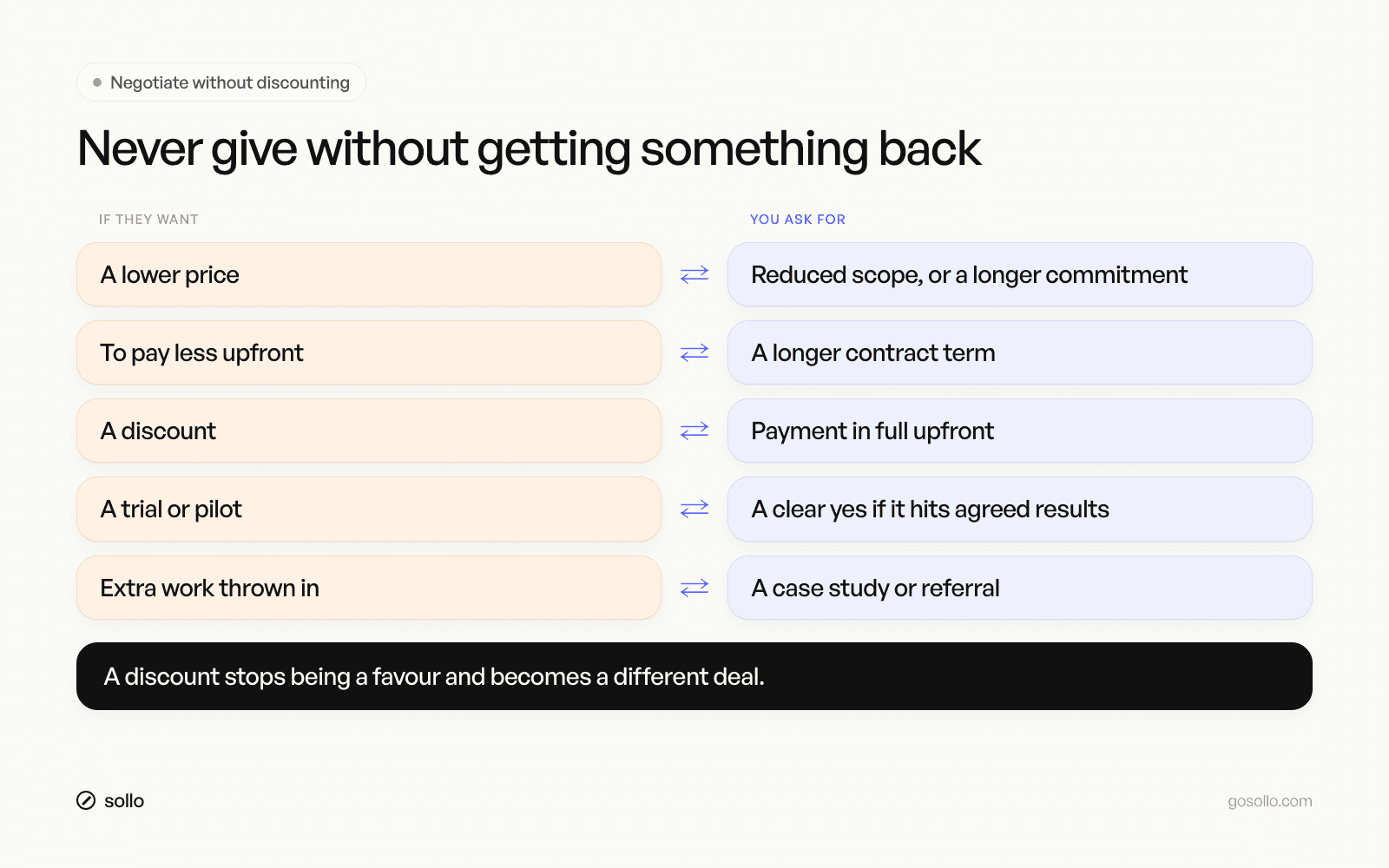
Trading like this turns a discount into a different deal on different terms. Sometimes they'll take the smaller scope, and often they'll realise they want the full thing after all, at the full price.
What do you say when a prospect says it's too expensive?
When a prospect says it's too expensive, ask "Compared to what?" and take them back to the cost of the problem you found in discovery. If the problem costs them $8,000 a month and your offer is $5,000, the price stops being the headline. Then stay quiet and let them respond.
This is why discovery matters so much. If you never got a number for the cost of the problem, your price has nothing to be compared against. (If that's you, read the discovery questions that win deals before your next call.)
Feel free to steal these scripts for the most common pushback:
They say | You say |
|---|---|
"It's too expensive." | "Compared to what?" Then take them back to the cost of the problem you found in discovery. |
"Can you do it cheaper?" | "I can. What would you like to take out?" |
"We need to think about it." | "Totally fair. It sounds like something's still holding you back. What is it?" |
"Send it over and I'll have a look." | "Happy to. Let's book 15 minutes to go through it together so you've got everything you need." |
"Another supplier is cheaper." | "They might well be. What made you want to talk to us anyway?" |
Practise these out loud with a friend. They'll feel clunky the first few times, but by the tenth run-through they'll sound like you.
When should you walk away from a deal?
Walk away when the deal goes past the walk-away point you set before the call, or when the client is already showing you how difficult they'll be to work with. A clean no is better than a client who resents the price, disputes every invoice and keeps asking for work outside scope.
Being willing to walk is also what gives you the confidence to hold your price in the first place, because prospects can sense desperation just as easily as they can sense calm.
I learned this the hard way. When I started JRNY in 2016 I had a product background and zero sales experience. Year one we did $30k ARR and nearly went under. I was off salary, living on savings, and saying yes to almost anything. Once I committed to learning sales properly, including how to hold a price and when to say no, we hit $500k ARR six months later. The deals got bigger once I stopped being scared of losing them.
What are the biggest negotiation mistakes to avoid?
The biggest negotiation mistakes are dropping your price straight away, over-explaining, filling the silence after you name your number, splitting the difference, and negotiating by email. Each one signals that your price is soft. Say your number, stop talking, ask questions, trade rather than concede, and have the conversation live.
Dropping the price straight away. It tells them the first number was made up.
Over-explaining. The more you justify, the more defensive you sound.
Filling the silence. Say your number, then stop talking.
Splitting the difference. Meeting in the middle usually leaves both sides unhappy (it's literally the title of the book).
Negotiating by email. Pick up the phone, because tone matters more than words here.
Most price objections can be headed off earlier, too. A tight pitch built around their problem, and a proposal written in their words, answer the value and risk questions before they ever become a negotiation.
Before your next deal where you expect pushback, work through these five things:
Fill in a one-sheet.
Write your accusation audit (three sentences).
Pick three calibrated questions from this post.
Decide your trades, so you never give something for nothing.
Practise the pushback scripts out loud.
FAQ
How do you respond to "it's too expensive"?
Ask "Compared to what?" and bring them back to the cost of the problem they described in discovery, then stay quiet. If they still push, label it ("It sounds like budget is the main worry") and ask a calibrated question such as "What would need to be true for this to work for you?"
Should I ever offer a discount?
Only as a trade. If they want a lower price, reduce the scope or ask for a longer commitment, and if they want a discount, ask for payment in full upfront. A discount for nothing teaches the prospect that your first number wasn't real, and it makes every future negotiation with them harder.
What is an accusation audit?
An accusation audit is a tactic from Chris Voss's Never Split the Difference. You say the negative things the other person is probably thinking before they say them, for example "You're probably thinking this is a lot of money right now." It takes the sting out and shows you understand their position.
What's the difference between "that's right" and "you're right"?
"That's right" means the prospect feels understood and agrees with your summary of their situation, which is when they become open to moving forward. "You're right" is usually a polite way of ending the conversation, so keep summarising their position until you hear "that's right".
Is it OK to negotiate price over email?
Avoid it where you can. Email strips out tone, and tone matters more than words in a negotiation, which is also why labels, mirrors and silence fall flat in writing. If a prospect pushes back by email, reply briefly and suggest a 15-minute call to talk it through.
How can Sollo help?
Sollo keeps every deal, conversation and note in one place, so when price comes up you've got the cost of the problem from discovery right in front of you. The AI sales agent helps you prep calls and coaches you on what to say next, which is handy when you're about to walk into a tricky negotiation.
Log every objection against the deal, and after a month you'll see which ones keep coming up. You can then deal with them earlier, in your pitch and your proposal, before they ever turn into a negotiation. If you're new to the full system, start with the 7-step sales system for solo consultants.