Early in my career I thought a great sales call meant a great presentation.
I'd turn up with the slides polished, the demo ready and every feature lined up, and then throw the lot at the prospect on the basis that if I showed them enough, they'd have to buy. It never worked, and they'd say "thanks, this is really interesting, we'll get back to you", and that was usually the last I heard of them.
It took me far too long to notice what the calls I won had in common. The prospect did most of the talking, I asked better questions, and by the time I got round to pitching they'd already told me why they needed it. That pattern is a sales call structure, and once you have one you follow on every call, you can see exactly which part broke when a deal goes sideways. This is the one I use.
TL;DR: A sales call that closes follows a 7-step run order: set the scene, understand the problem, find the root cause, uncover the impact, quantify the pain, summarise until they say "that's right", then give a short tailored pitch and book the next step. The prospect talks at least half the time, and you don't pitch before step 6.
What does a great sales call look like?
A great sales call is a back-and-forth conversation where the prospect does at least half the talking. The seller sets the scene, asks questions, digs into the real problem, puts a number on it, plays it back, and only then gives a short pitch built around what they just heard. A bad call is a 40-minute monologue.
It helps to picture two calls side by side. In the bad one, the seller talks for 40 minutes straight, opening with their company history, working through every feature and finishing with "so, what do you think?"
In the great one, the conversation goes back and forth. The pitch comes late and it's short, and every sentence of it connects to something the prospect said earlier.
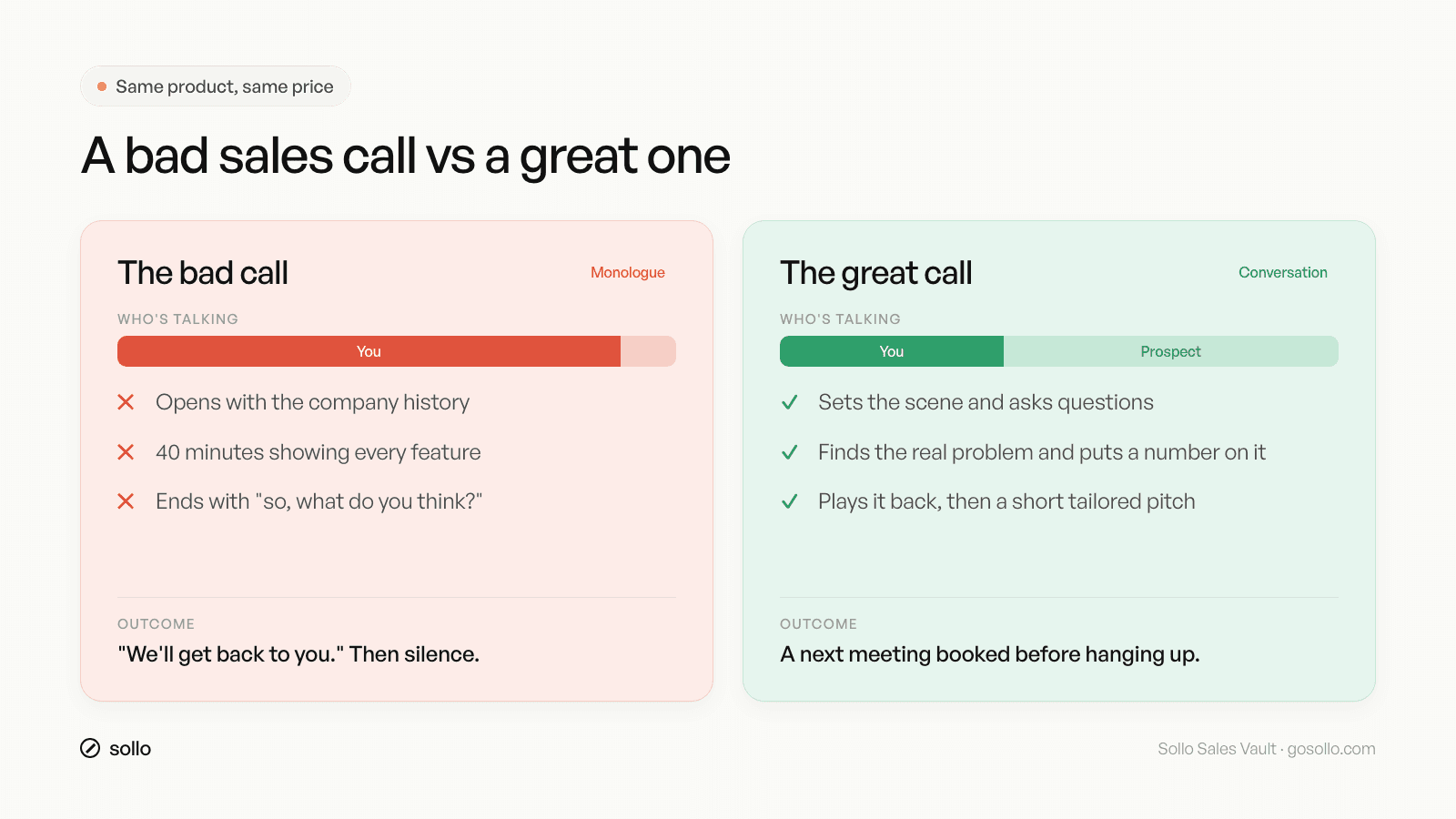
It's the same product at the same price in both calls, and they end in completely different places.
I learned this the hard way. When I founded my fintech company JRNY in 2016, I had a product background and zero sales experience. Year one we did $30k ARR and nearly went under. I committed to actually learning sales, and six months later we were at $500k ARR. A lot of what I learned in those six months is baked into this run order.
What is the best sales call structure?
The best sales call structure is a fixed run order you use every time: set the scene, understand the problem, find the root cause, uncover the impact, quantify the pain, summarise to earn the right to pitch, then give a short tailored pitch and prescribe the next step. The prospect does most of the talking until step 6.
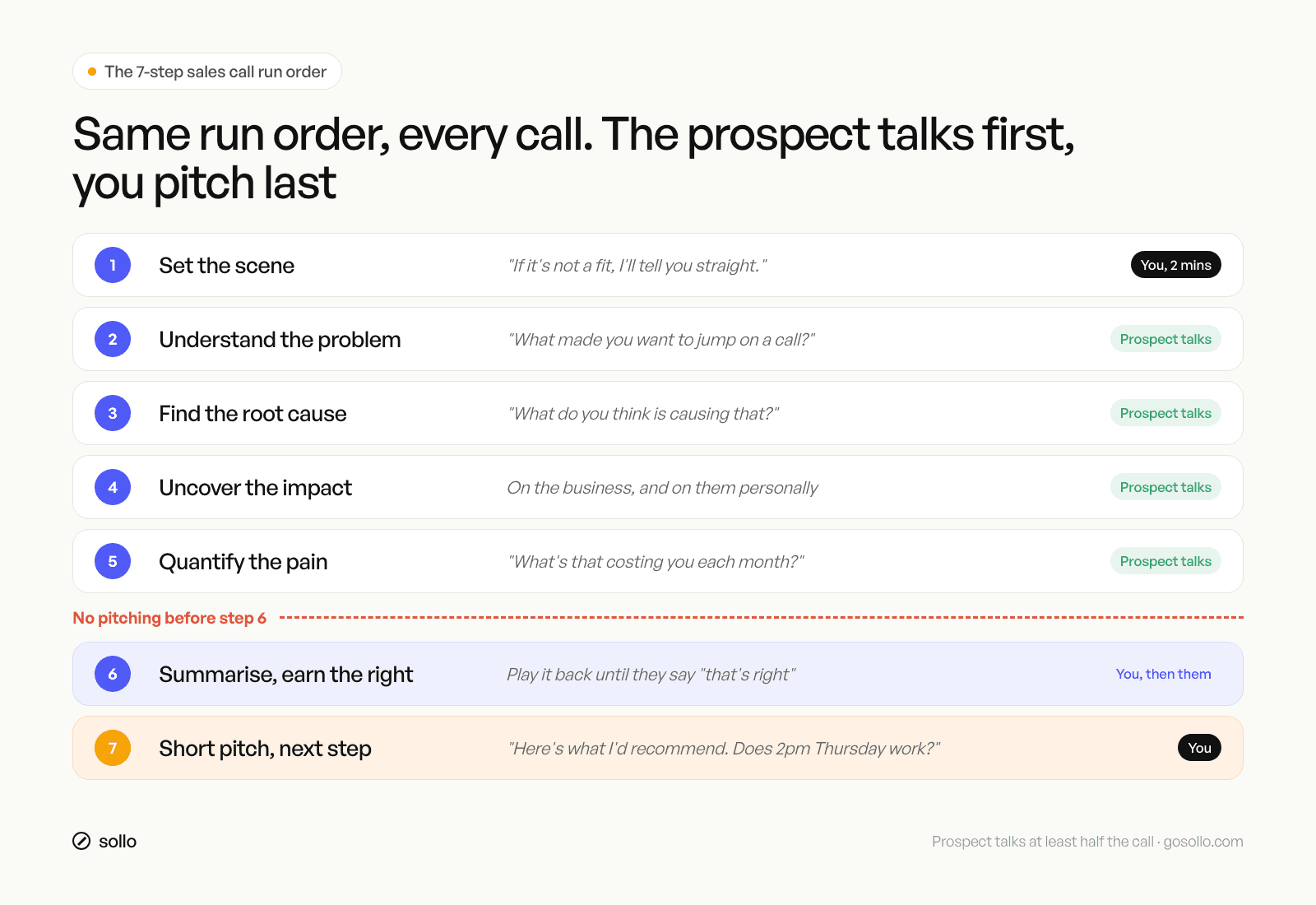
Think of it as a sales call script for the shape of the call rather than every word. You're welcome to steal the lines below, but the order is what really matters. Most people learn sales backwards (they pick up a few tactics, try them on a call and move on to the next shiny thing when they don't work), whereas a run order lets you improve one step at a time.
Step 1: Set the scene (first 2 minutes)
Start by agreeing how the call will go. It relaxes the prospect and puts you in control without being pushy.
"I'm glad we could meet today. We've got 30 minutes, is that still good for you? I'd like to spend most of it understanding what's going on in your business, and if it looks like I can help, I'll show you how. If it's not a fit, I'll tell you straight, and you can do the same. Sound fair?"
Pay attention to that last bit. Giving them permission to say no makes it far more likely they'll be honest with you, and honesty is what you need to sell well.
Step 2: Understand the problem
Ask an open question and then stop talking.
"What made you want to jump on a call today?"
Whatever they say first is usually the surface, which is fine, because you only need it as a starting point for the questions that follow.
Step 3: Find the root cause
This is where most people stop too early. Ask:
"What do you think is causing that?"
When they answer, ask again, because you're looking for the thing underneath the thing. In my experience the real problem sits about two questions deeper than the one they walked in with.
Step 4: Uncover the impact
How is this problem affecting the business, and how is it affecting them personally? People buy to fix business problems, and they buy faster when it's keeping them up at night. If you know Keenan's GAP Selling, this is you mapping their current state honestly before you talk about any future state.
Step 5: Quantify the pain
Now you want a number, whether that's money, hours lost or opportunities they've missed.
"Roughly what do you think that's costing you each month?"
If they tell you it's costing them $8,000 a month, your $5,000 offer suddenly looks very different. Without a number, your price has nothing to be compared against, so it just looks expensive.
The exact questions I use for steps 2 to 5 are in the discovery call question bank, and you're very welcome to steal them.
Step 6: Summarise and earn the right to pitch
Play back what you heard, in their words, until they say "that's right". Chris Voss makes a big deal of those two words in Never Split the Difference, and for good reason: it's the moment they feel properly understood.
"So if I've got this right, you're getting plenty of interest, but deals stall after the first call because there's no follow-up system, and that's costing you around three clients a month. Have I missed anything?"
If they correct you, that's a good sign they're engaged, so adjust and play it back again. Don't move on until they agree.
Step 7: Short, tailored pitch and a prescribed next step
Now you pitch, and you keep it short by only talking about the parts of your offer that fix the problems they've just described (the rest can wait). If you want a structure for this bit, how to pitch your services walks through it.
Then tell them what happens next, and book it before you hang up.
"Here's what I'd recommend. I'll put together a proposal based on everything we've covered, and we walk through it together on Thursday. Does 2pm work?"
Never leave a call with "I'll send something over and you let me know", because that's where deals go to die.
You can grab the one-page call run sheet and the 8-phrases swap card in the free Sollo Sales Vault. I'd print the run sheet and keep it next to your screen.
How much should you talk on a sales call?
Probably less than you think. A good talk ratio is the prospect doing at least half the talking, and you not pitching anything before step 6. If you catch yourself explaining features in the first 15 minutes, stop and ask a question. Desperate salespeople fill the silence, while great salespeople stay quiet and listen.
Every minute you spend talking about yourself early in the call is a minute you're not learning what they actually need, and if you don't know what they need, you'll end up pitching the wrong thing.
A simple way to check yourself is to record your next few calls (with permission) and listen back to the first 15 minutes. If your voice dominates, you know what to fix. It's uncomfortable to hear, but it's also the fastest sales training you'll ever get.
What's the difference between a discovery call and a sales call?
A discovery call is about understanding the problem, root cause, impact and cost (steps 2 to 5). A sales call wraps discovery inside a full run order, adding the scene-setting, summary, short pitch and next step. For smaller deals it's one call. For bigger ones, discovery happens first and the proposal walkthrough is the booked next step.
Either way the order stays the same, and you never skip discovery to get to the pitch faster. If a deal is big enough to need a separate discovery call, step 7 simply becomes "let's book time to walk through a proposal", and that's when you'll want a proper consulting proposal ready to go.
Which phrases are hurting your sales calls?
Filler phrases like "just checking in", "does that make sense?", "to be honest" and "what do you think?" weaken your calls without you noticing. They sound unsure, hand control to the prospect, or hint you weren't being honest before. Swapping them for specific, confident alternatives makes you sound like the guide rather than someone asking for a favour.
I wrote a LinkedIn post about the 8 phrases that make sales calls worse. It got 124,000 impressions, 728 reactions and 197 comments, which tells you a lot of people recognise themselves in it. Here are six of the swaps:
Instead of | Try | Why it works |
|---|---|---|
"Just checking in..." | "Last time you mentioned X. How's that going?" | Shows you listened and gives them something real to reply to. |
"Does that make sense?" | "How does that land for you?" | Asks for their view instead of testing whether they understood. |
"To be honest..." | Just say the thing. | Stops implying you weren't honest before. |
"What do you think?" | "Here's what I'd recommend." | You're the expert. Guide them. |
"Is now a good time?" | "Have you got 20 minutes to walk through this?" | Specific and easy to say yes to. |
"We're the best at..." | "Here's what happened for a client in your position." | A story is proof. A claim is noise. |
They're small changes, but prospects notice them. The full set of 8 is on the swap card in the Vault.
What are the most common sales call mistakes?
The most common sales call mistakes are pitching before you understand the problem, accepting the first answer, skipping the number, letting the prospect decide the next step, and winging it with no run order. Each one either sends you in with the wrong pitch or leaves the deal with nowhere to go after the call.
Pitching before you understand the problem. You'll pitch the wrong thing.
Accepting the first answer. The real problem is usually two questions deeper.
Skipping the number. Without it, your price has nothing to be compared against.
Letting them decide the next step. You're the guide here, so guide.
Winging it. Same run order, every call, so you can improve it.
The fourth one does more damage than people realise. Matthew Dixon and Ted McKenna found in The JOLT Effect that 40% to 60% of buying processes end in no decision, and a prescribed next step with a date in the diary is your best defence against that.
How do you review a sales call afterwards?
Score yourself on three yes-or-no questions straight after every call: did I set the scene and give them permission to say no, did I get a number for the cost of the problem, and did I leave with a date in the diary? Three yeses and you're already ahead of most people selling today.
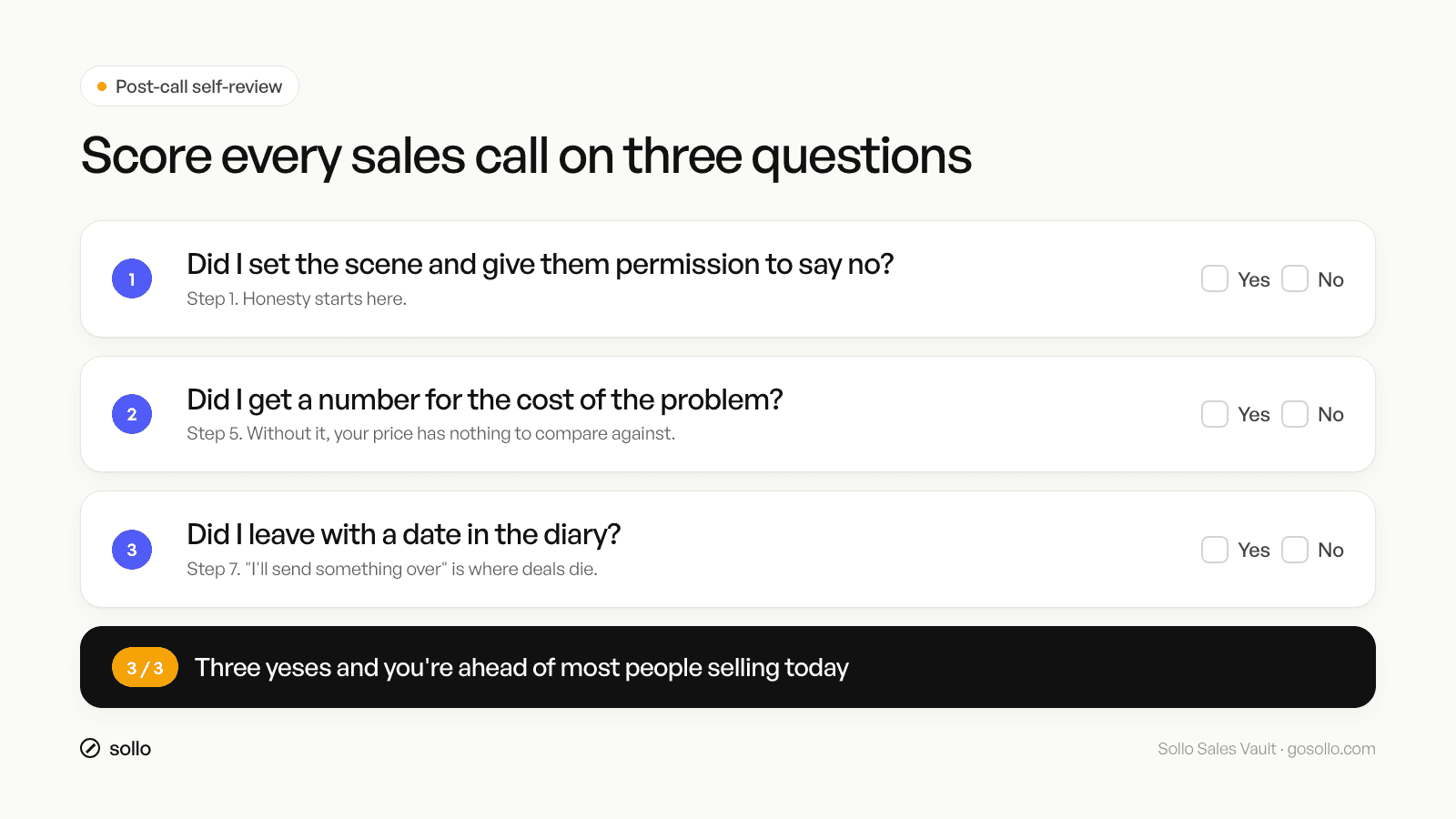
The review only takes a couple of minutes, so do it before you check email, while the call is still fresh. Any "no" tells you exactly which step to practise next time, and over a month you'll start to see where you tend to slip, which is the step to work on.
If the next step was booked, your job now is keeping the deal warm until then, which I cover in how to follow up with prospects.
FAQ
How long should a sales call be?
For most consultants and coaches, 30 minutes is enough to run all seven steps. Spend the first two minutes setting the scene, most of the call on the problem, root cause, impact and cost, and the last few minutes on a short pitch and booking the next step. Bigger deals may split discovery into its own call.
Should I use a sales call script?
Use a script for the structure and a few key lines rather than every word. The 7-step run order tells you what comes next, and lines like the scene-setter and the summary give you a confident starting point. Reading a full script word for word makes you sound robotic and stops you listening.
When should I talk about price on a sales call?
Only after step 5, once you've got a number for what the problem costs them. Price means very little on its own, but compared against a monthly cost they've just told you about, it becomes an easy decision. If they ask earlier, give a range and say you'd like to understand their situation first.
What if the prospect won't give me a number in step 5?
Help them estimate it by asking about time lost each week, deals missed or hires delayed, then do the maths together. A rough number they agree with beats a precise one you invented. If there's genuinely no cost to the problem, that's useful to know too, because it may not be a fit.
What should I do if a sales call goes badly?
Run the three-question review and find the step that broke. Most bad calls come from pitching too early, stopping at the surface problem, or ending without a booked next step. Because you use the same run order every time, one bad call gives you a specific thing to practise instead of a vague feeling.
How can Sollo help?
Sollo is the sales platform built for one-person businesses. Before a call, it pulls everything you know about a lead into one place, and the AI sales agent can prep the call for you, so you walk in knowing their world. After the call, your notes and next steps live on the deal, with follow-up reminders so nothing slips between calls.
It can also turn your discovery notes into a proposal and coach you on what to say next. As Mostyn Wilson, a leadership development consultant, put it: "Simple but powerful enough to hit the ground running. The built-in AI coach is incredibly helpful. I don't just know what to do next, but how to do it."