Somebody at a barbecue asks what you do, and you say "I'm a consultant". Their eyes glaze over, and the conversation drifts off towards the sausages.
A while ago I wrote a LinkedIn post about exactly this, arguing that most people are bad at introducing themselves. It became my most-saved sales post ever, with 1,827 saves and 152,000 impressions, which told me that loads of skilled people can't explain what they sell in one sentence, and they know it.
When the intro falls flat, the real issue is usually a fuzzy offer. If you're inventing a new package on every sales call, your sales will feel like a lottery, so this post starts with how to create an irresistible offer and then shows you how to say it in one line.
TL;DR: To create an irresistible offer, pick a market in real pain, sell a specific destination (a number, a timeline, a transformation), score it on Alex Hormozi's Value Equation, add bonuses against objections, reverse the risk, then name it and price the outcome. Finish with a one-line intro: "I help [who] get [result] in [timeframe] without [the thing they hate]."
Where does a great consulting offer come from?
A great consulting offer sits where four things overlap: what you love doing, what you're good at, what the world needs and what people will pay for. That's the Japanese idea of Ikigai, "a reason for being". Offers built in that overlap are easier to sell because you care, you're credible and buyers already want it.
Grab a piece of paper and write a list under each of the four:
What you love. The work you'd happily do on a Tuesday afternoon with nobody watching.
What you're good at. The skills people already come to you for.
What the world needs. The problems people are losing sleep over right now.
What you can be paid for. The problems people already spend money trying to fix.
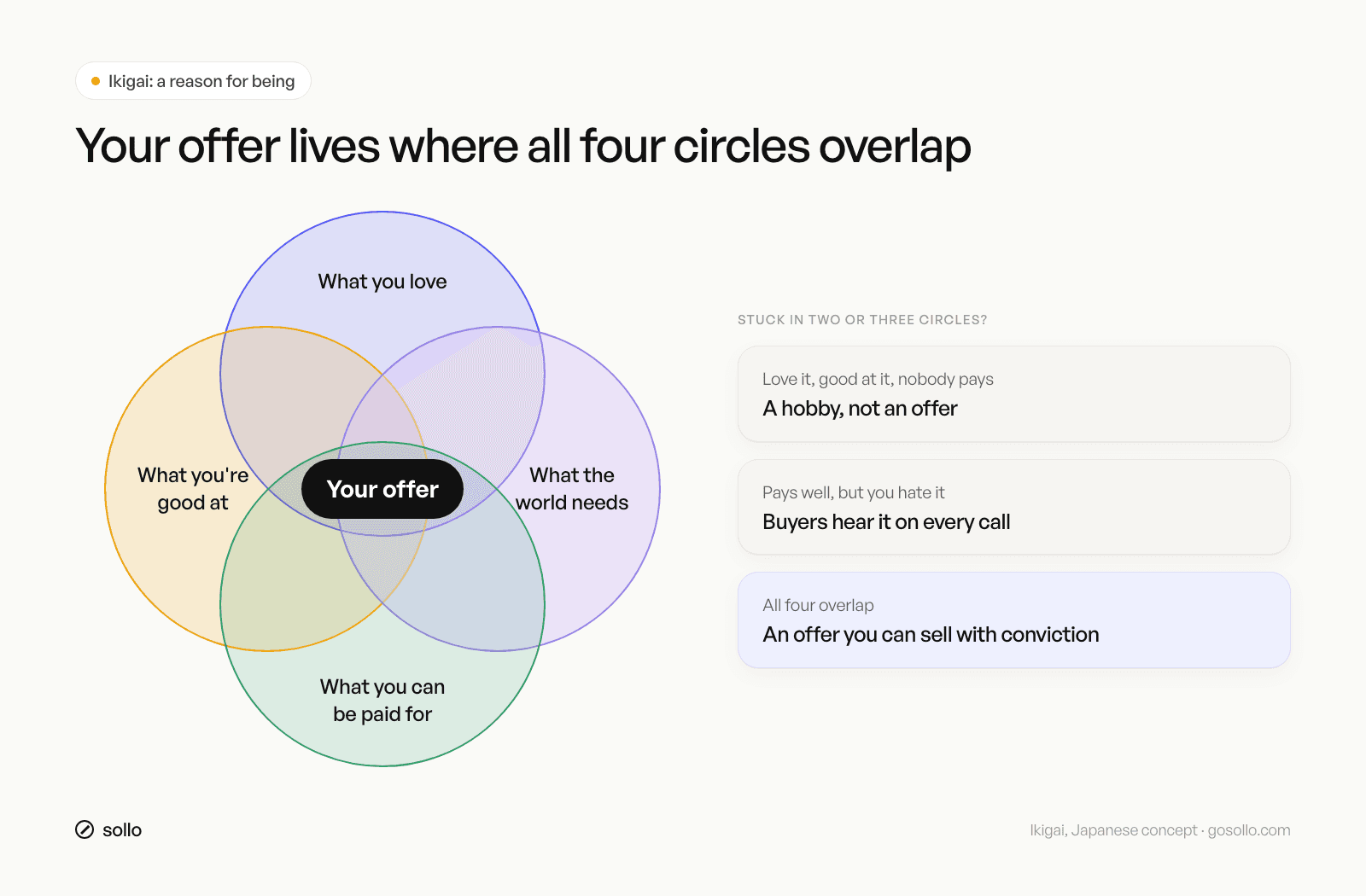
Most people who struggle to sell are sitting in two or three of the circles. Either they love the work and they're good at it but nobody will pay for it, or it pays well and they hate it, which comes through on every sales call. Find the spot where all four meet and selling gets much easier.
What makes an offer irresistible?
An offer is irresistible when the value clearly outweighs the price. Alex Hormozi's Value Equation from $100M Offers explains what drives value: a bigger dream outcome and higher belief it'll work push value up, while a longer wait and more effort for the buyer push it down. Improve all four and the price starts to feel small.
Hormozi calls the end result a Grand Slam Offer, something so good people feel daft saying no, and you build one by changing what's actually in the offer rather than polishing the copy around it.
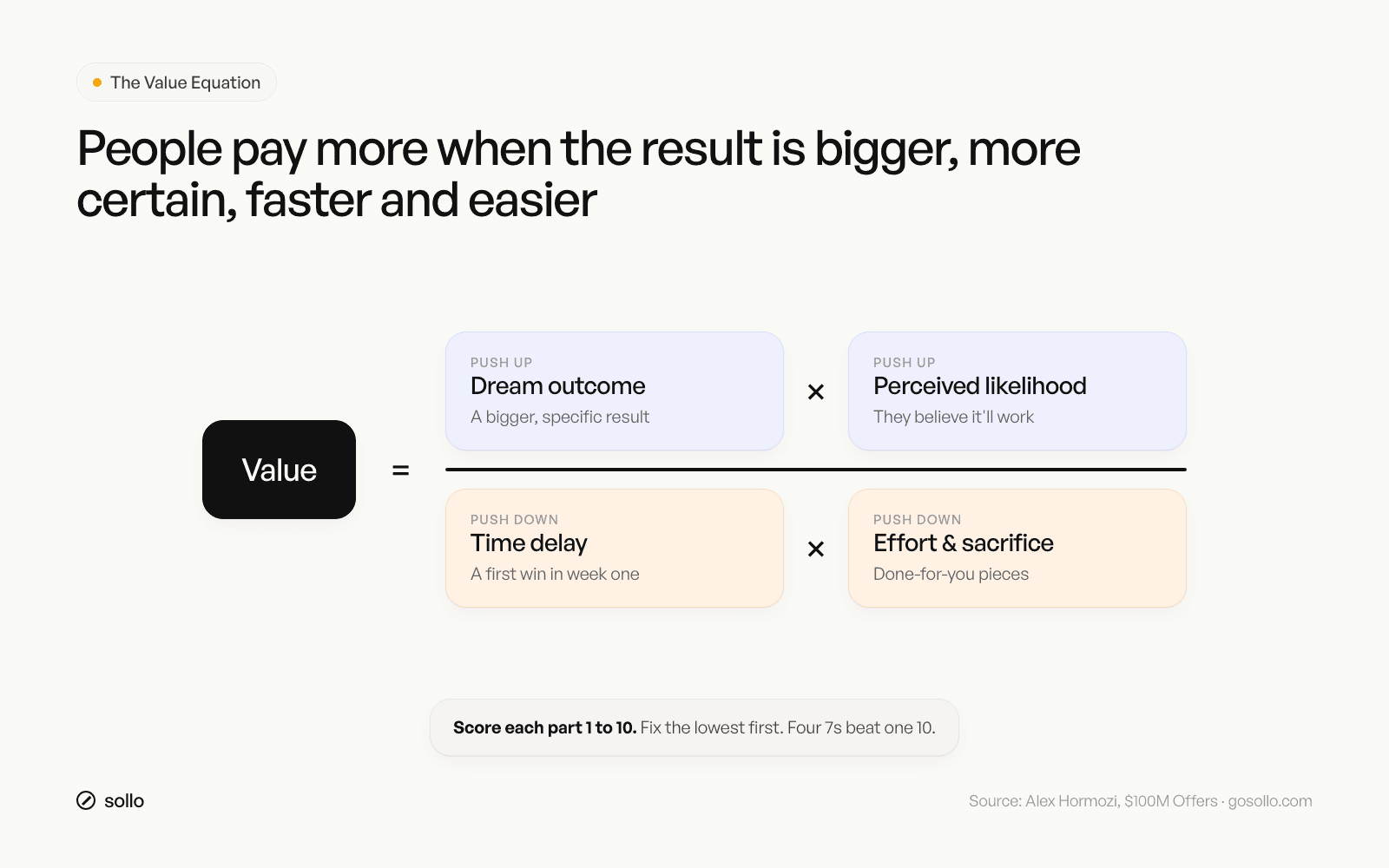
In plain English, people pay more when the result is bigger, they believe it'll work for them, they get it faster, and it takes less effort on their side. Every step below pulls on at least one of those four levers, so it's worth keeping them in mind as you go.
How do you create an irresistible offer, step by step?
Use six steps: pick a market that's in pain, sell the destination instead of activities, score your offer on the Value Equation and fix the weakest part, add bonuses that kill specific objections, take the risk off the table with a guarantee, then name it and price it like a product. The whole thing takes about 45 minutes.
Step 1: Pick a market that's actually in pain
Most offers die before they're built, because the market was never in enough pain to pay. Before you design anything, check your market against four signals.
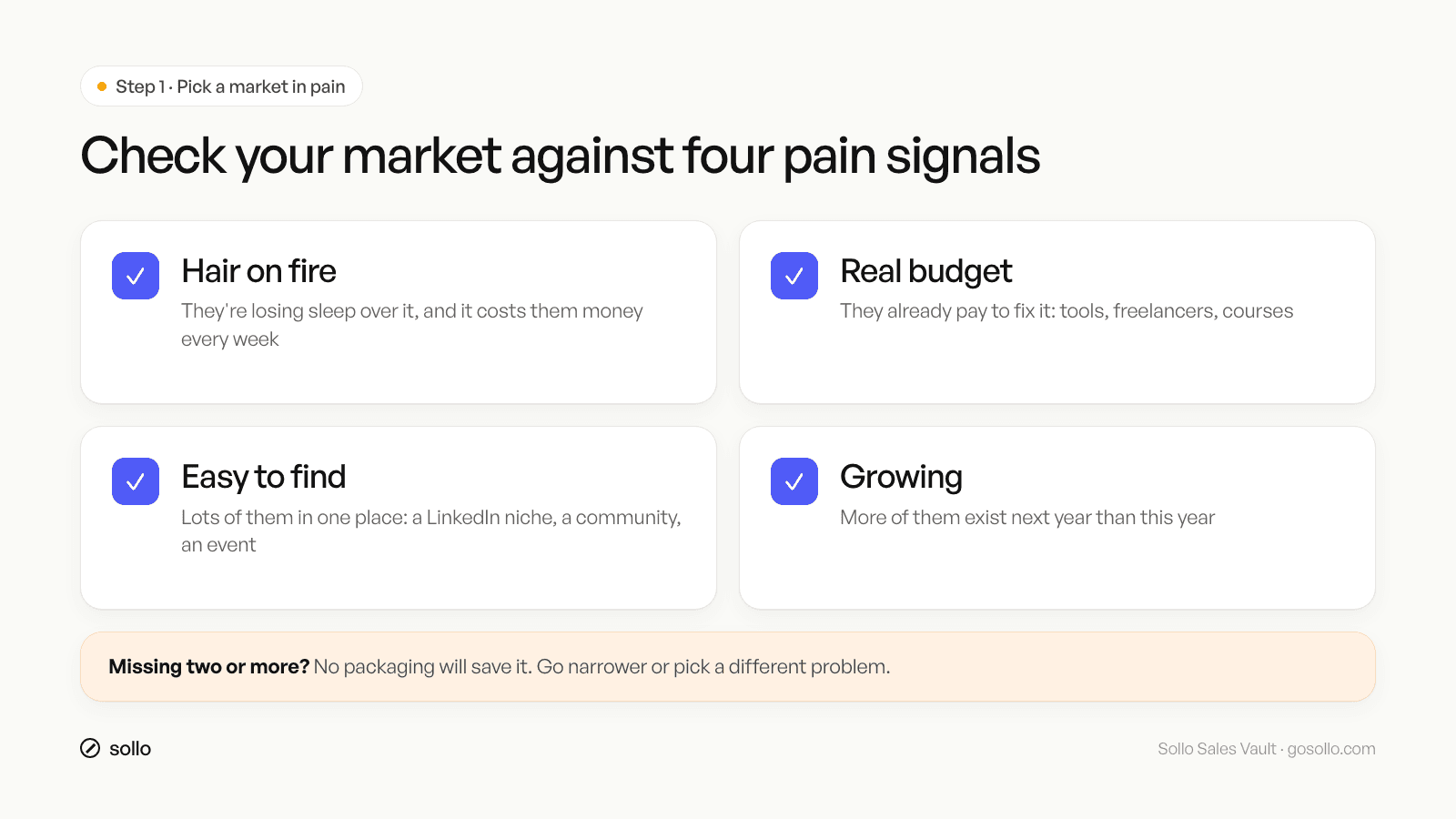
Hair on fire. They're losing sleep over this, and it's costing them money every week.
Real budget. They already spend money trying to fix it: tools, freelancers, courses.
Easy to find. You can reach lots of them in one place: one LinkedIn niche, one community, one industry event.
Growing. More of them exist next year than this year.
If you're missing two or more, clever packaging won't rescue it, so go narrower or pick a different problem.
Step 2: Sell the destination
Weak offers describe activities, like "four coaching calls a month", "weekly content" or "access to the community".
Strong offers describe where the buyer ends up, which means getting really clear on three things:
The number. Revenue, clients, hours saved, deals closed.
The timeline. 30 days, 90 days, by the end of the quarter.
The transformation. Where they are now, and where they are when you're done.
"Sales coaching" describes an activity, whereas "close your first $10k month in 90 days" describes a destination, and people will happily pay a lot more for the second one.
Step 3: Score it on the Value Equation
Score your current offer from 1 to 10 on each of the four parts (dream outcome, perceived likelihood, time delay and effort), then fix the lowest one first.
The quickest win is usually on the bottom of the equation: give them a first result in week one, and do part of the work for them with templates and done-for-you pieces. Both shrink time and effort without you having to promise a bigger outcome.
Try not to obsess over a single score, either, because an offer with all four parts at 7 will almost always beat one with a single 10.
Step 4: Stack bonuses that kill objections
Each bonus should remove a specific reason someone might say no. Write down the five objections you hear most, then build one bonus to answer each of them.
They think | You add |
|---|---|
"I don't have time" | Done-for-you templates |
"I'm not technical" | A step-by-step playbook |
"What if I get stuck?" | Weekly office hours |
"Will this work for someone like me?" | Case studies from their industry |
"I need results fast" | A 7-day quick-start plan |
Each bonus also maps to a lever in the Value Equation: templates cut effort, case studies raise belief, and a quick-start plan shortens the time delay.
Step 5: Take the risk off the table
Every buyer has one question in the back of their mind: "What happens if this doesn't work?" Your guarantee answers it before they have to ask, and you can pick one of three types:
Conditional: "Do the work, and if you don't see the result, you get a full refund."
Performance-based: "If you don't hit [outcome], you don't pay."
Milestone-based: "Walk away at any checkpoint, no questions asked."
A bolder guarantee makes the yes easier, and in my experience the people who take you up on it are a tiny fraction of the extra people it brings in.
Step 6: Name it and price it like a product
An offer with no name is just a conversation, but once you name it, it becomes something people can point at, remember and tell their mates about. Nobody remembers "coaching", whereas "The Sollo Challenge" is a thing you can actually buy.
On price, charge for the outcome rather than the hours, because hourly pricing caps your income and makes the buyer count your time. Premium prices signal quality, while cheap ones make people wonder what's wrong. When I've seen founders double their price, the headaches usually halve, because clients who pay more show up more committed.
If you want to do this properly, grab the Offer Builder worksheet and Value Equation scorecard in the free Sollo Sales Vault, which walks you through all six steps as fill-in fields.
How do you introduce yourself in one sentence?
Use this formula: "I help [who] get [result] in [timeframe] without [the thing they hate]." It works because every part of it is about the buyer: who it's for, the destination, how fast they get there and the pain they avoid. If you can't fill it in yet, your offer isn't finished.
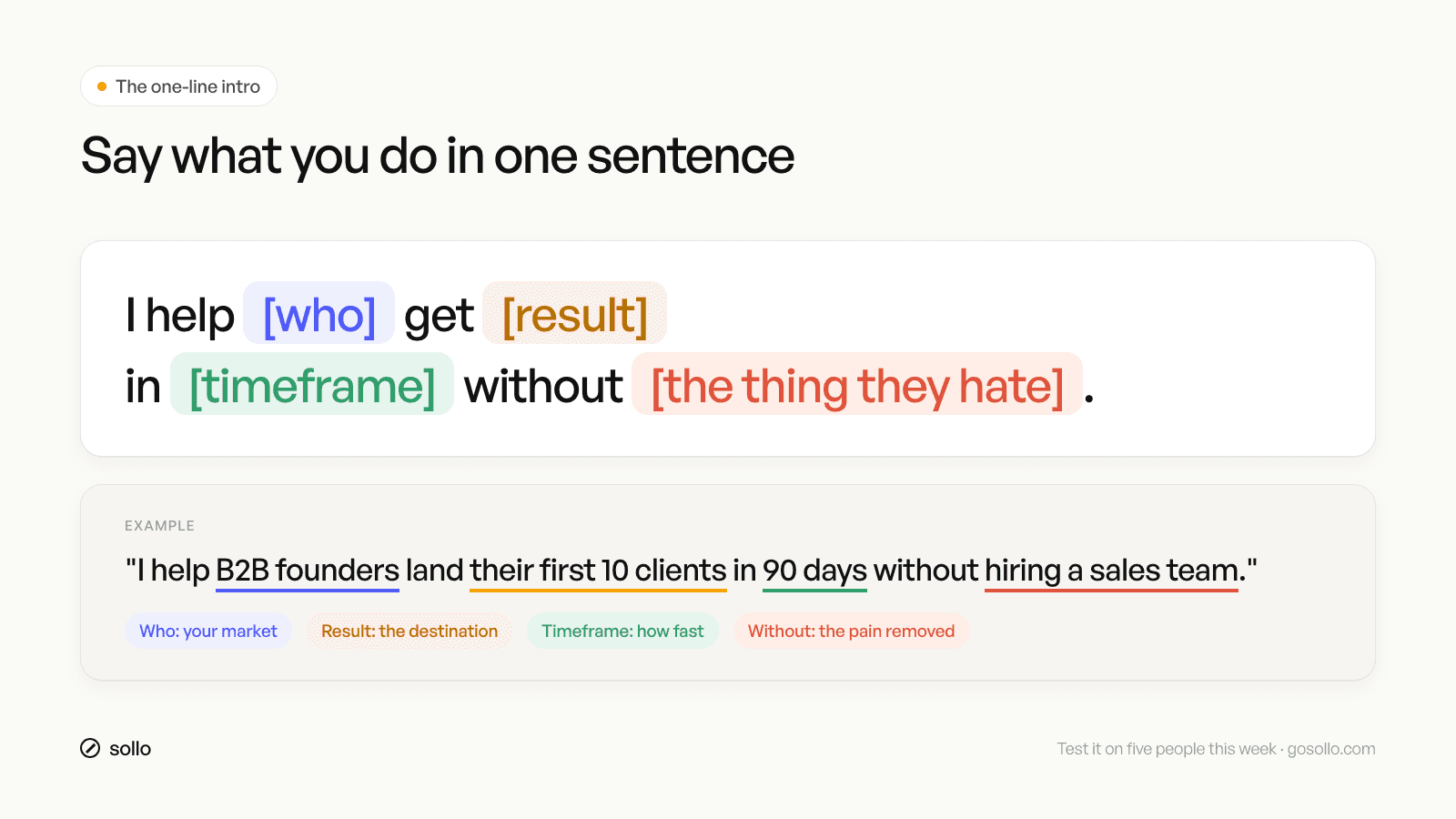
For example: "I help B2B founders land their first 10 clients in 90 days without hiring a sales team."
Look at how each part lines up with the steps you just did:
[who] comes from Step 1, the market in pain.
[result] and [timeframe] come from Step 2, the destination.
[the thing they hate] comes from Steps 3 and 4, the effort and objections you've removed.
That's why a good intro is so hard to write without a good offer, since the sentence is really just the offer compressed into one line.
Then test it by saying it out loud to five people this week and watching their faces. If they lean in and ask "how?", you've got it, and if they nod politely and change the subject, go back to Step 2 and get more specific.
How do you package consulting services without reinventing the offer on every call?
Package consulting services as one named offer with a fixed destination, a set of objection-killing bonuses, a guarantee and an outcome-based price. Then sell that same offer at least 20 times before you change it. Consistency is what lets you see what's working, and it stops you from discounting on the spot to close.
The alternative is one offer for one client, a different add-on for the next and a discount for the one after that, until every call becomes a roulette of what you'll say yes to. As well as being exhausting and bad for your margins, it makes it impossible to get better, because you're never selling the same thing twice.
Once you've got one offer, everything downstream gets easier: your outreach to find clients carries one clear message, your pitch tells one story, and your proposals can follow the same structure every time. It's the reason offer is Step 1 of the 7-step sales system for solo consultants.
What are the most common offer mistakes?
The most common consulting offer mistakes are offering everything to everyone, changing the offer on every call, pricing by the hour and listing features instead of results. Each one weakens the Value Equation: a vague market lowers belief, constant changes stop you improving, and hours or features make buyers focus on cost instead of outcome.
Offering everything to everyone. The wider you go, the weaker it sounds.
Changing the offer on every call. Pick one, sell it 20 times, then improve it.
Pricing by the hour. It caps your income and makes the buyer count your time.
Listing features. What people pay for is the result those "four calls a month" get them.
FAQ
What is an irresistible offer?
An irresistible offer is one where the value so clearly outweighs the price that saying no feels like a mistake. It promises a specific result in a set timeframe, makes the buyer believe it'll work, removes effort and objections with bonuses, and takes the risk away with a guarantee. Alex Hormozi calls this a Grand Slam Offer.
How do I price a consulting offer?
Price a consulting offer on the outcome it delivers, anchored against what the problem costs the buyer, which you'll learn in discovery. Premium prices signal quality and attract more committed clients. Avoid hourly pricing, because it caps your income and makes buyers watch the clock instead of the result.
What is the Value Equation?
The Value Equation is Alex Hormozi's formula from $100M Offers: value equals dream outcome times perceived likelihood of achieving it, divided by time delay times effort and sacrifice. To raise the value of your offer, make the result bigger and more believable, and make it faster and easier to get.
How specific should my one-line intro be?
Specific enough that the right person says "that's me" and everyone else knows it isn't for them. Name a clear type of client, a measurable result and a timeframe. "I help businesses grow" is far too broad, whereas "I help B2B founders land their first 10 clients in 90 days" works.
Should I offer a guarantee as a solo consultant?
Usually, yes, because a guarantee answers the buyer's biggest silent question: what if this doesn't work? Pick the type you're comfortable with, whether conditional (refund if they do the work and don't see results), performance-based or milestone-based. In practice, very few clients claim it compared with the extra people who say yes.
How can Sollo help?
Once your offer is locked in, Sollo uses it to shape everything else. You add your offer once, and it informs who you reach out to, what your outreach says and the proposals you build, so you sell the same sharp offer every time instead of reinventing it on each call.
Sollo's AI sales agent drafts outreach around your offer, preps your calls and builds proposals from your discovery notes, all inside the sales platform built for one-person businesses, where your leads, conversations and pipeline live together in one place.