
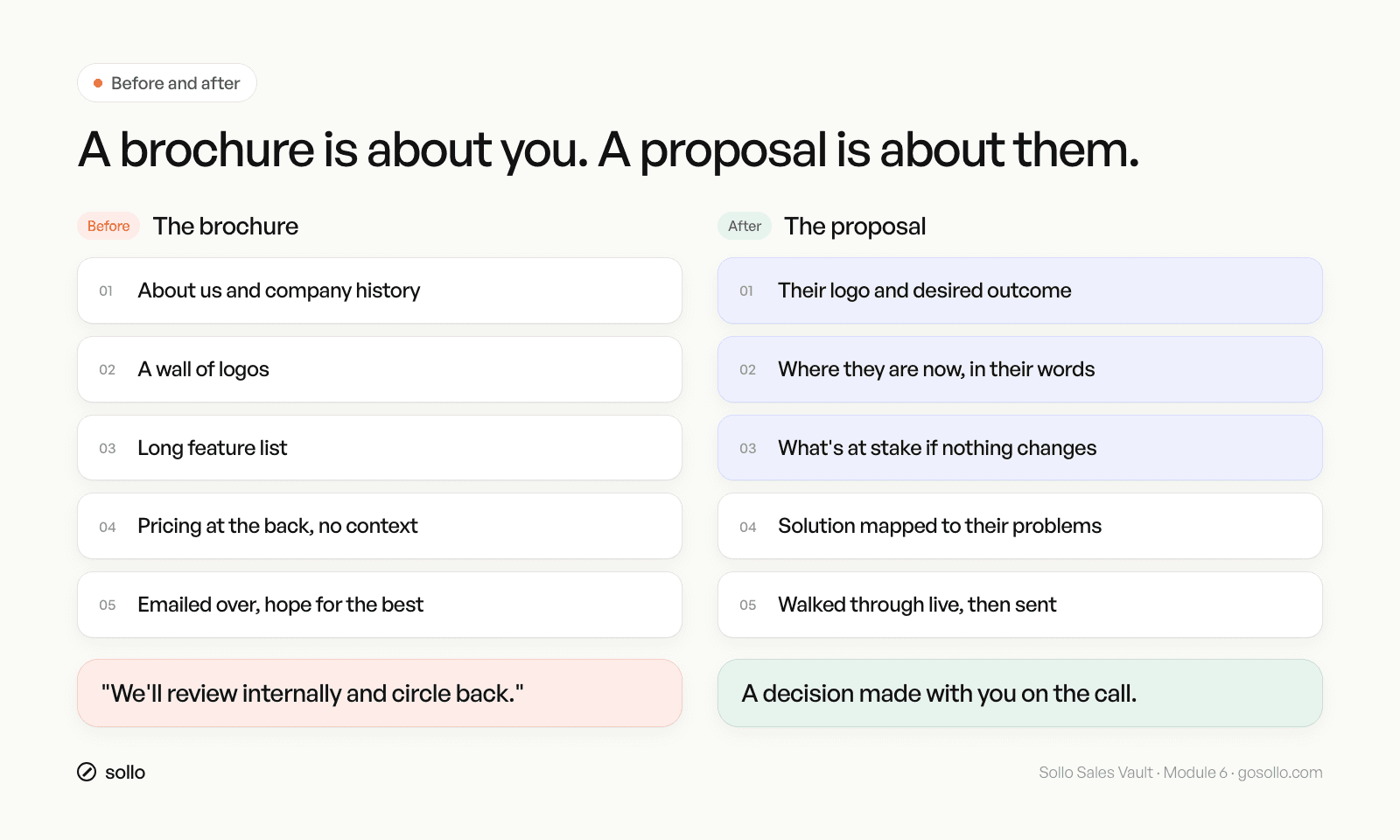
Early in my career, I thought a good proposal meant a polished template: company history, a wall of logos, a long feature list and pricing tucked away at the back. I'd send it over and hope for the best.
Nearly always I'd get the same reply, "Thanks, we'll review internally and circle back", and they never did circle back.
It took losing deal after deal before I saw the problem. My proposals were all about me, and people sign proposals that are about them and their business. So if you're wondering how to write a consulting proposal that actually gets signed, this is the structure I switched to, along with how to present it so it doesn't vanish into someone's inbox.
TL;DR: To write a consulting proposal that gets signed, make roughly 80% of it about the client and 20% about your solution. Use a 10-part structure: cover, how we got here, where they are now, where they want to go, what's at stake, your solution, timeline, case study, investment and next step. Walk them through it live before sending it.
Why do most consulting proposals fail?
Most consulting proposals fail for one of three reasons. They're generic, with the same template and a new name swapped in. They're all about you, full of history, logos and features. Or they're sent and forgotten, emailed over with no walkthrough, so the client reads it alone with nobody there to answer questions.
The proposal stage is where a lot of perfectly winnable deals die, and it's usually down to one of these:
It's generic. The same template with their name swapped in, and they can tell.
It's all about you. Your history, your logos, your features, and very little about their problem.
It's sent and forgotten. Emailed over with no walkthrough, so they read it alone, without you there to answer questions.
You'll notice that design doesn't come into any of these, and a beautifully formatted proposal can still fail on all three counts. What fixes it is the structure of the document and the way you deliver it.
What is the golden rule of a good proposal?
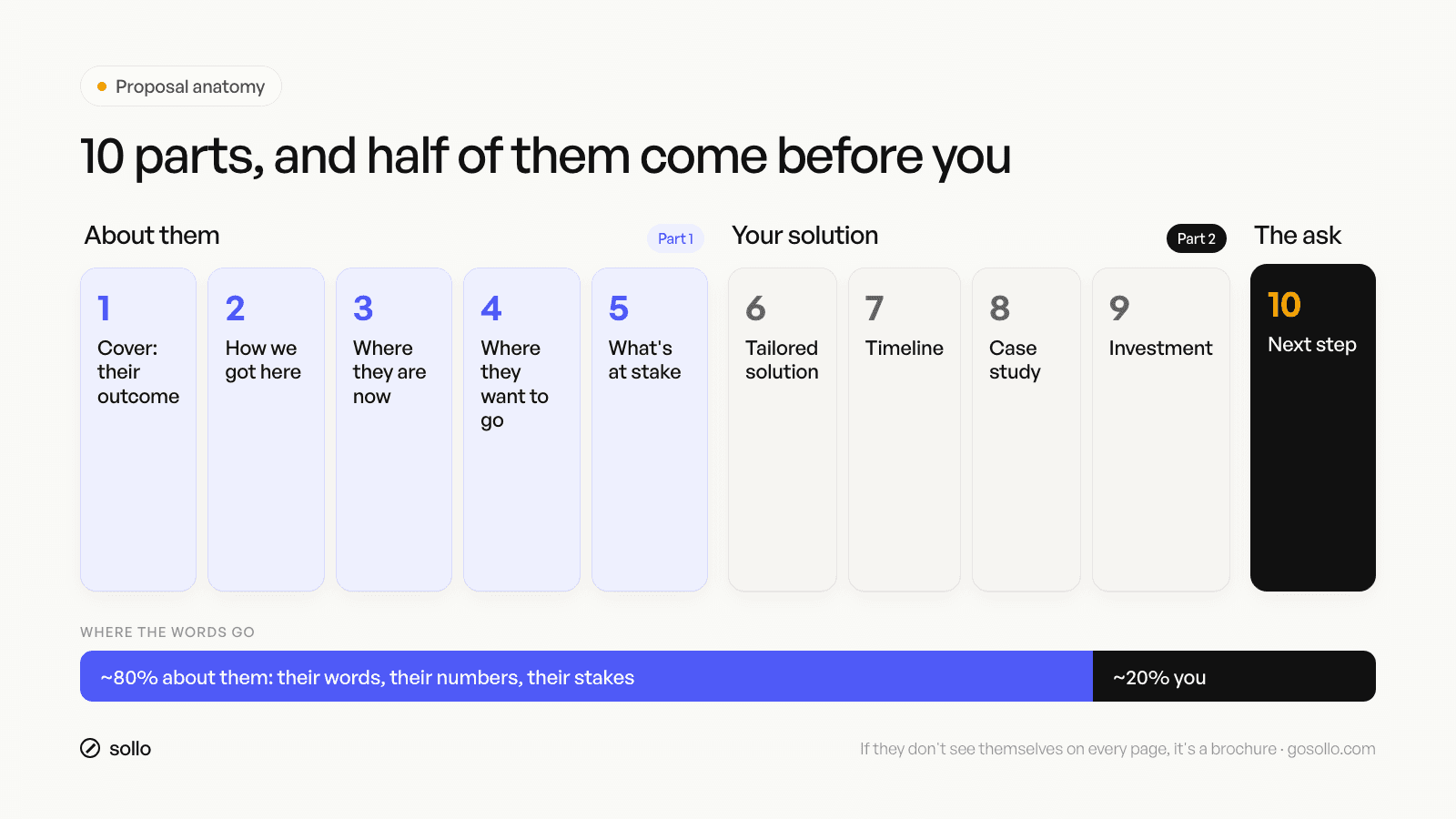
The golden rule is that the client should see themselves on every page, otherwise you've written a brochure. Aim for roughly 80% about them and 20% about your solution. And only write the proposal after a proper discovery call, because everything good in it comes from what they told you.
Look at the structure below and count how far you get before you talk about yourself at all. It's five sections, which is half the document, and that's deliberate. By the time they reach your solution, they've already read their own problem described better than they could have described it themselves, so your solution reads as the obvious answer rather than a sales pitch.
The raw material comes from discovery: their exact words, their numbers and their timeline. If you don't have those yet, you're not ready to write a proposal, and the best thing you can do is go back and ask.
What should a consulting proposal include?
A consulting proposal should include ten parts in three groups. About them: cover, how we got here, where they are now, where they want to go, and what's at stake. Your solution: tailored solution, timeline, case study and investment. The ask: one prescribed next step. That order keeps the client at the centre.
# | Section | What goes in it |
|---|---|---|
1 | Cover | Their logo and their desired outcome, not "Proposal for services" |
2 | How we got here | A short recap of your conversations so far |
3 | Where they are now | Their current state in their words: problems, root causes, impact |
4 | Where they want to go | The future state, with their numbers and timeline |
5 | What's at stake | The cost of doing nothing |
6 | Your tailored solution | Mapped problem by problem: "You told us X, so we'll do Y" |
7 | Timeline | What happens and when, made to feel simple |
8 | Case study | One matched transformation story from someone like them |
9 | Investment | Priced against the stakes, ideally two or three options |
10 | The next step | Start date, onboarding call, where to sign |
I'll go through each part in turn, and if you'd rather start from a ready-made version, grab the proposal template in the free Sollo Sales Vault.
Part 1: About them
1. Cover: their logo and their desired outcome. Open with them and their goal. "Acme: doubling qualified leads by March" is far stronger than "Proposal for services", because it tells them before they've turned a page that this document is about their goal.
2. How we got here. A short recap of your conversations so far, which proves you listened and reminds them why they're reading this. A few lines is plenty.
3. Where they are now. Their current state in their own words, covering the problems, the root causes and the impact. If you've done discovery well, they'll read this section and think "yes, that's exactly it", which is why I'd call it the most important page in the document.
4. Where they want to go. The future state, with those problems gone. Use the numbers and timeline they gave you rather than the ones you'd like them to have.
5. What's at stake. This is the cost of doing nothing, so if they told you the problem is costing them $15,000 a month, put that figure here, because this is the section that makes your price look sensible.
Part 2: Your solution
6. Your tailored solution. Map it problem by problem: "You told us X, so we'll do Y." Leave out anything that doesn't connect to what they said, even if it's a part of your service you're proud of.
7. Timeline. Set out what happens and when. Buyers nearly always overestimate how long and painful getting started will be, so make it feel simple, with week one, week two and the first result laid out plainly.
8. Case study. One relevant transformation story from someone like them, showing where they were, what changed, where they ended up and how long it took. A single well-matched story will do more for you than ten logos.
9. Investment. Priced against the stakes from section 5, so the number has context. Two or three options work well, because they move the question from "should I do this?" to "which one?"
Part 3: The ask
10. The next step. Make it prescribed, specific and easy to say yes to, with the start date, the onboarding call and where to sign all spelled out, so they never have to work out what to do next.
How should you present a consulting proposal?
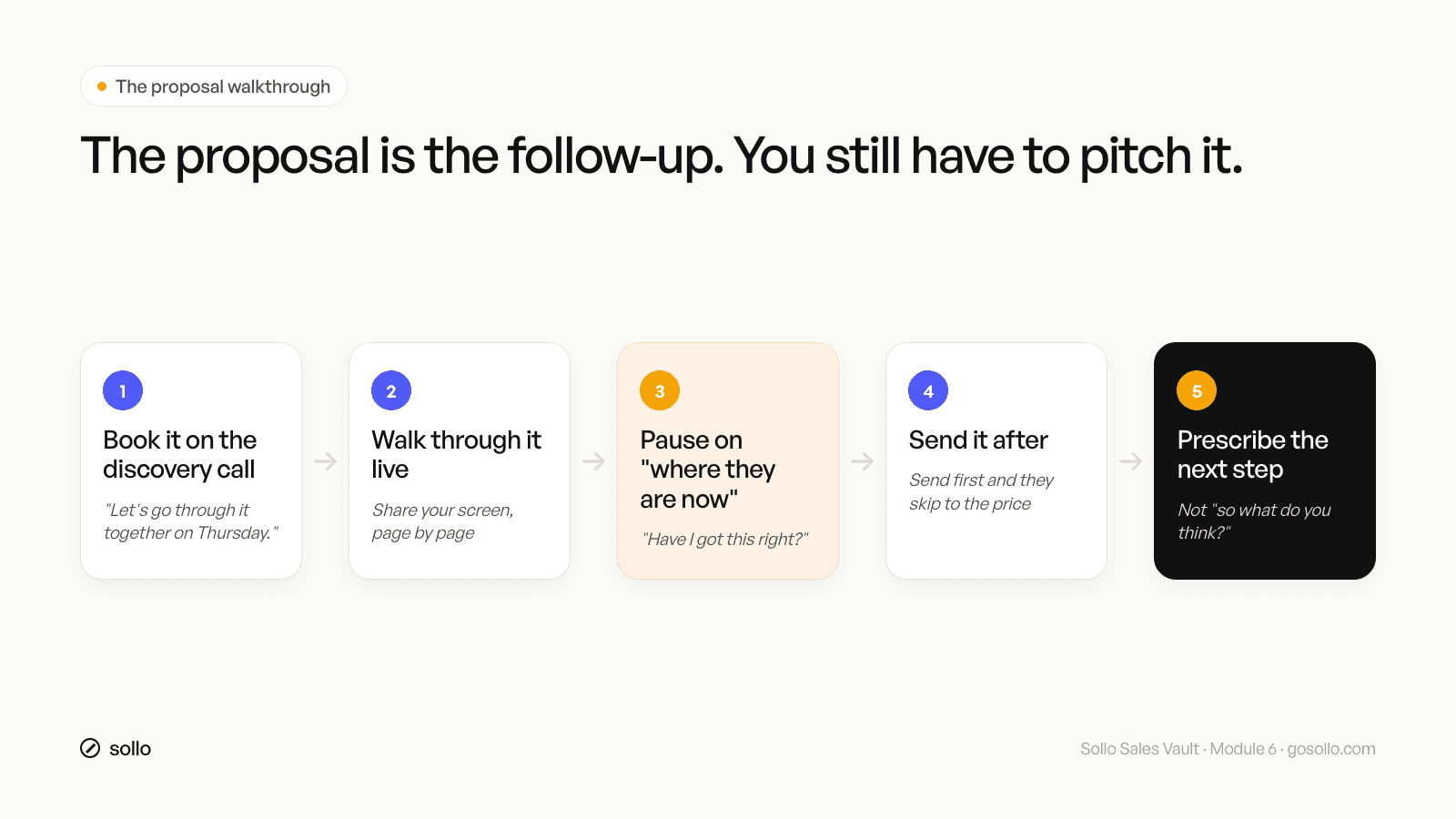
Present a consulting proposal live, never by email alone. Book the walkthrough on the discovery call, share your screen and go page by page, pause on "where they are now" until they agree, and only send the document afterwards. Then prescribe the next step instead of asking what they think.
This is where most people go wrong, even with a great document. The proposal is effectively your follow-up, and you still have to pitch it.
Step 1: Book the walkthrough on the discovery call
Try not to leave the discovery call without a date in the diary for the walkthrough. Something as simple as this does the job:
"I'll put together a proposal, and let's go through it together on Thursday."
Step 2: Walk them through it live
Share your screen and go page by page. You control the pace, and you're there to answer questions the moment they come up.
Step 3: Pause on "where they are now"
When you reach their current state, stop and check it with them:
"Have I got this right?"
Then wait until they're nodding along. If they correct something, that's great, because you can fix it there and then, and agreement on the problem is what makes the price make sense later on.
Step 4: Send the document after the walkthrough
If you send it first, they'll skip straight to the price, and seen without the context of their problem and the stakes, almost any number feels expensive.
Step 5: Prescribe the next step
Rather than asking "so what do you think?", tell them what happens next, because you're the guide here. It mirrors the ask at the end of a good pitch, which I break down in how to pitch your services.
Does this proposal structure actually work?
Yes, it does. When the proposal is built from discovery notes, written mostly about the client, and walked through live, it stops being a document that gets "reviewed internally" and becomes a decision the client makes with you on the call. It also makes proposals much faster to write, because the structure never changes.
Clare Kitching, an AI Consultant, put it like this:
"I thought I had about $180k of deals in play. It was closer to $400k. I've since written six proposals in three weeks and already won two."
Six proposals in three weeks is the part I love. Once the structure is set and your discovery notes are ready, writing a proposal stops being a weekend job, and you get to spend your time on the walkthrough, which is where deals are actually won.
What are the most common proposal mistakes?
The most common proposal mistakes are opening with an "About us" page, using irrelevant case studies, pricing with no context, adding things the client didn't ask for, and emailing the proposal and waiting. Each one either shifts the focus to you, raises new doubts, or leaves you chasing a prospect who has gone quiet.
Opening with an "About us" page. Move it to the back or cut it entirely.
Using irrelevant case studies. A scale-up story won't convince an early-stage founder.
Pricing with no context. A number on its own nearly always feels expensive.
Adding things they didn't ask for. Every extra item is another thing to question.
Emailing it and waiting. That's how you end up chasing. If you're already there, read my guide on how to follow up with prospects.
How do you fix your current proposal today?
Take your last proposal and count the pages about the client versus the pages about you. Then rebuild it in the 10-part structure using your discovery notes, add the cost of inaction to section 5, and book the walkthrough before you send anything. If most pages are about you, it was a brochure.
Take your last proposal and count the pages about them versus about you.
Rebuild it in the 10-part structure using your discovery notes.
Add the cost of inaction to section 5.
Book the walkthrough before you send anything.
Some people will still push back when they reach the investment page, so here's how to handle price objections without discounting.
FAQ
How long should a consulting proposal be?
Long enough to cover the ten parts and no longer. Many sections are only a few lines: "How we got here" might be one paragraph, and the next step a single page. Rather than chasing a page count, make sure every page either describes their situation or shows how you'll change it.
Should I send a proposal before or after the meeting?
Send it after the meeting. Walk the client through it live first, then send the document. If you send it beforehand, they'll skip straight to the price and read it without the context of their problem or the cost of doing nothing, and a price seen on its own almost always feels too high.
How many pricing options should a proposal include?
Two or three options work well. They move the client's question from "should I do this?" to "which one should I pick?" Price each option against the stakes you set out in the "what's at stake" section, so every number has context and feels proportionate to the problem.
What is the 80/20 rule for proposals?
Roughly 80% of a proposal should be about the client (their situation, goals and what's at stake) and about 20% about your solution. If they can't see themselves on every page, what you've written is really a brochure, and brochures tend to get "reviewed internally" and forgotten.
Can I use a consulting proposal template?
Yes, for the structure. A good template gives you the ten sections and their order, while the words themselves come from you. Sections 3, 4 and 5 must be built from your discovery call, in the client's own language, because a template filled with generic copy is exactly why proposals fail.
How can Sollo help?
The slowest part of a proposal is turning scattered notes into a document. Sollo builds your proposal straight from the discovery notes saved on the lead, in this exact 10-part structure, so it's written in their words from the start.
That frees you up to spend your time on the walkthrough instead of formatting, and with follow-up reminders on every deal in your pipeline, nothing drifts into "we'll circle back" territory.