
Early in my career I'd finish a sales call feeling great. The prospect would say "thanks, this is really interesting, we'll get back to you", I'd say "brilliant, I'll send something over and you let me know", and then I'd never hear from them again.
It took me far too long to see the pattern. The deals were slipping away in the gap after each call, because I had no idea when to follow up with prospects, what to say, or how to keep track of who I owed a message to. Most solopreneurs I talk to have exactly the same leak, so this is the follow-up system I'd use if I were starting again.
TL;DR: Follow up on the date you agreed, rather than whenever you remember. Book the next step before each call ends, recap the same day, and follow a set rhythm after outreach, calls and proposals. Make each follow-up about them ("Last time you mentioned X. How's that going?"), keep conversations in one place, and stop after a clean no.
Why do you keep losing deals between conversations?
Deals die between conversations for three reasons: there's no booked next step, there's no record of what was said or who's due a reply, and the follow-ups are generic "just checking in" messages. Fix those three and most of the leak stops. Talent has little to do with it: you need a system you follow every time.
No booked next step. "I'll send something over and you let me know" hands control to a busy person with 50 other priorities, which is where most deals go to die.
No record. The conversation lives in LinkedIn, the proposal in Gmail, the notes in your head. A week later you can't remember what they told you, or that you promised to reply.
Generic follow-ups. "Just checking in" gives them nothing to respond to, so they don't bother.
It also helps to know who your real competitor is. Matthew Dixon and Ted McKenna found in The JOLT Effect that 40% to 60% of buying processes end in no decision, so silence after a good call usually means a busy person drifting back to doing nothing, rather than a firm no.
How many times should you follow up with a prospect?
Most people give up far too early. A useful rule of thumb is 7-11-4: before most people buy, they need around 7 hours of interaction with you, 11 touchpoints and 4 different mediums, such as LinkedIn, email, a call and an event. One message and one follow-up won't get you there, so no reply to your first message is completely normal.
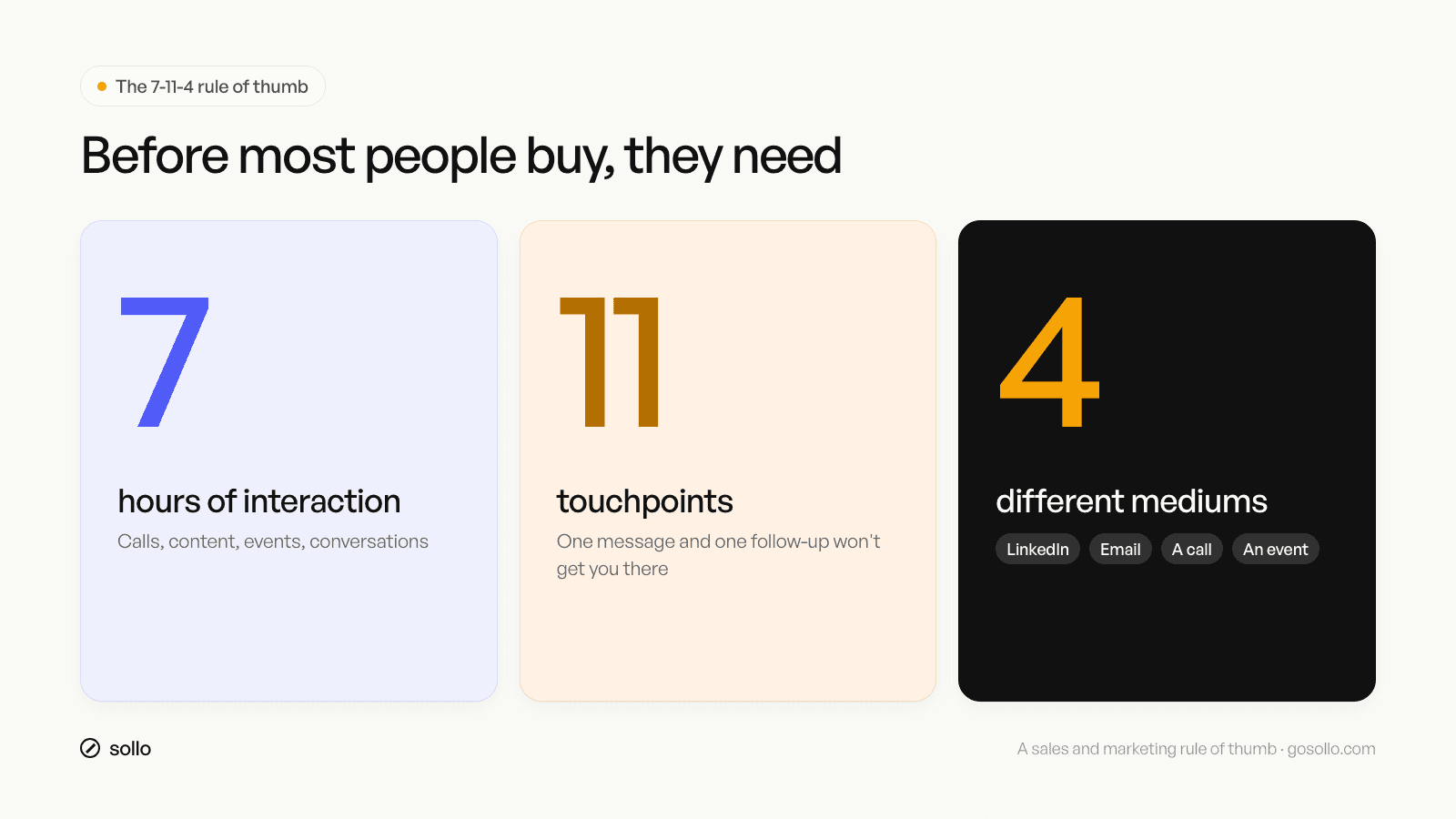
That changes how you think about follow-up. Rather than chasing, you're building up enough time and trust that buying from you starts to feel safe.
It also explains why the channel matters. If all 11 touchpoints are LinkedIn DMs, you're one voice in a crowded inbox, so mix it up with a comment on their post, an email with something useful, a short voice note or an invite to a small event.
How do you know when to follow up with prospects?
You know when to follow up because you agreed it with them, or because it's on a set rhythm. After first outreach, follow up a few days later, then change medium. After a call, recap the same day with the next step already booked. After a proposal, the follow-up is a 15-minute call you booked in the walkthrough.
This is the rhythm I recommend. Treat it as my rule of thumb and adjust it to how fast your buyers move.
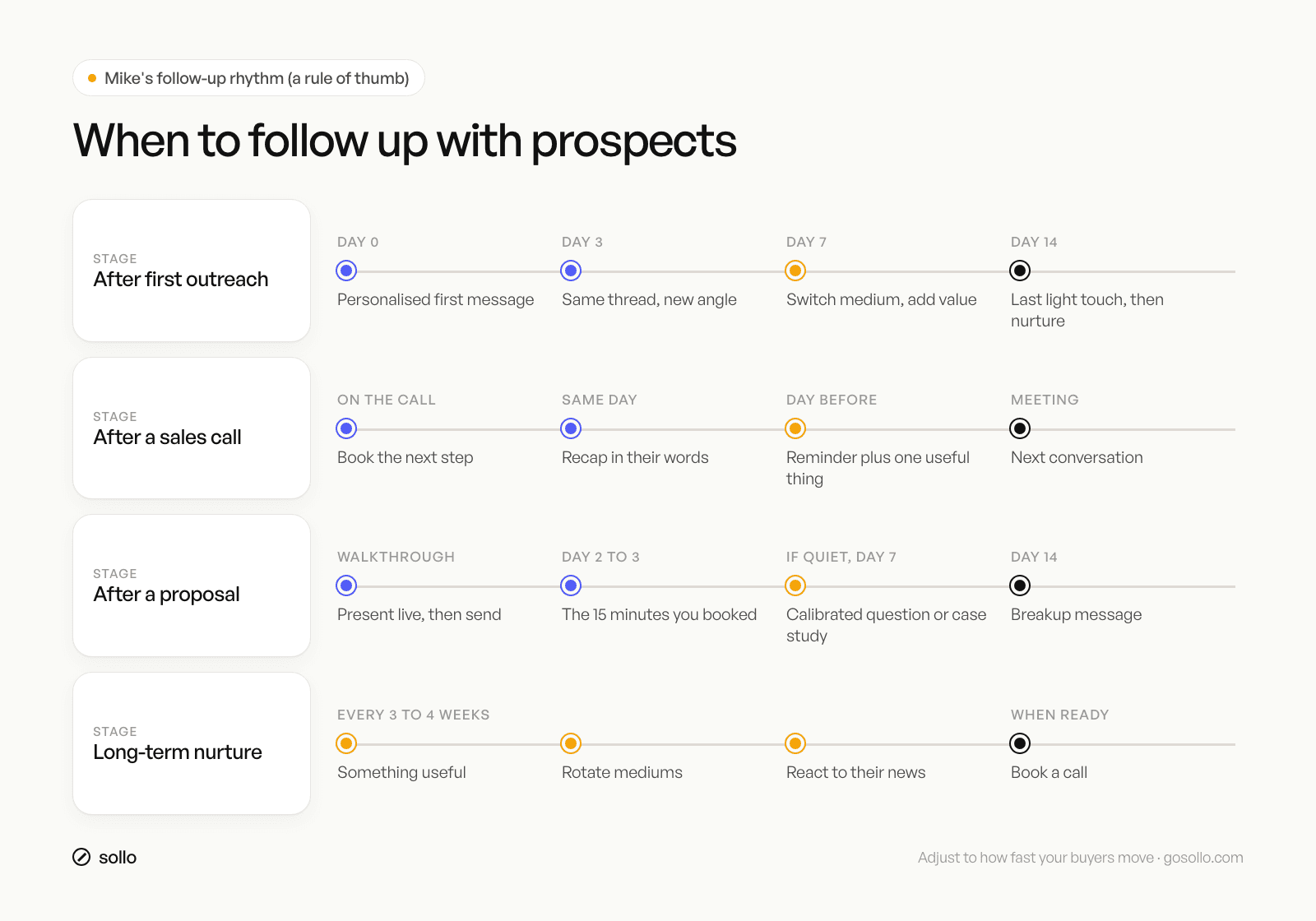
After first outreach (no reply yet)
Day 3: a short follow-up in the same thread with a new angle. One line, one easy question.
Day 7: switch medium. Comment on something they posted, or send an email with a resource that fits their world.
Day 14: one last light touch, then move them to long-term nurture, with no guilt trips.
Keep your new outreach going while this runs. My rule is 5 new, personalised people a day, which gives you a steady stream of first messages to follow up on.
After a sales call
The most important follow-up happens before the call ends, so book the next step while you're both still on the line:
"Here's what I'd recommend. I'll put together a proposal based on everything we've covered, and we walk through it together on Thursday. Does 2pm work?"
Same day: a short recap in their words. The problem, what it's costing them, and the date you agreed.
The day before the next meeting: a quick reminder with one useful thing attached.
After a proposal
Emailing the proposal and waiting is a recipe for silence. Walk them through it live first, send the document afterwards, and during the walkthrough book 15 minutes a few days later to answer questions. If they say "send it over and I'll have a look", try:
"Happy to. Let's book 15 minutes to go through it together so you've got everything you need."
If they go quiet, around day 7: a calibrated question, such as "What's the biggest thing holding you back?", or a short case study that answers a question they raised.
Day 14: the breakup message (more on that below).
Long-term nurture
For people who aren't ready yet, stay useful every three to four weeks, rotating mediums. You're building up those 7 hours and 11 touchpoints so that when the timing changes, you're the first person they think of.
There's more on building a pipeline worth following up on in how to find clients as a consultant, and the full picture sits in the 7-step sales system for solo consultants.
What should a sales follow-up message say?
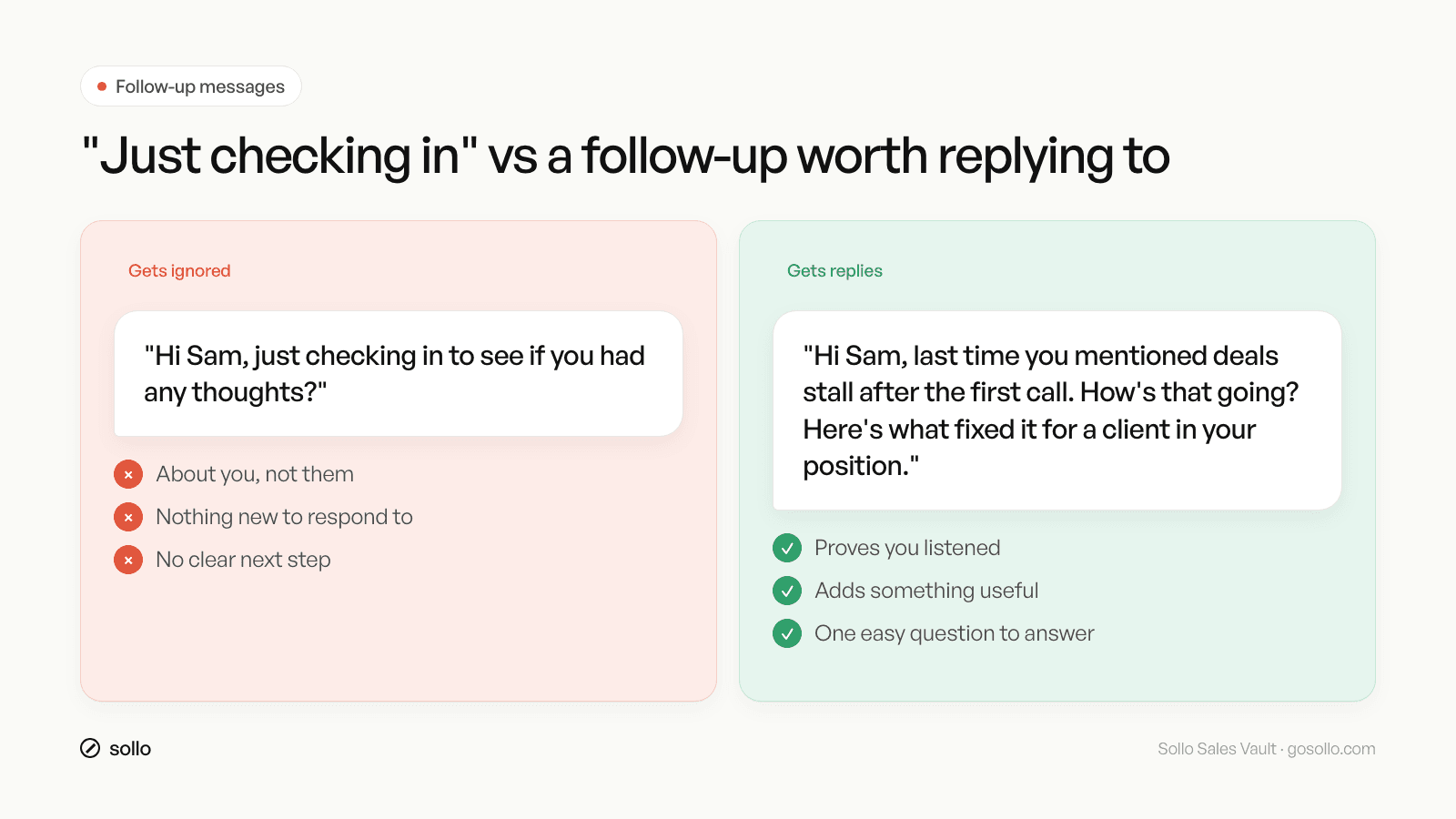
A good sales follow-up message should be about the prospect. Refer back to what they told you, add something useful, and ask one easy question. Swap "just checking in" for "Last time you mentioned X. How's that going?" It proves you listened, gives them a reason to reply and moves things forward instead of just reminding them you exist.
Instead of | Try |
|---|---|
"Just checking in..." | "Last time you mentioned X. How's that going?" |
"Any thoughts on the proposal?" | "You said the main worry was getting started. Here's what week one looks like." |
"Is now a good time?" | "Have you got 20 minutes to walk through this?" |
"Let me know what you think." | "Here's what I'd recommend as a next step." |
It's also worth spreading your value touches across the four mediums in the 7-11-4 rule, and these are all ideas you can borrow straight away:
Medium | Value-add follow-up ideas |
|---|---|
Comment thoughtfully on their post. Send a DM with a post or framework that fits a problem they mentioned. | |
A short note with a relevant case study, an article, or an answer to a question they asked on the call. | |
WhatsApp or voice | A 30-second voice note or quick video message reacting to their news, a hire or a launch. |
Calls and events | An invite to a small event, a workshop or a 15-minute call to walk through something useful. |
One more habit works brilliantly: reply to everyone who comments on your content, and reach out to people who engage with it. They've given you a relevant reason to message them, and they're already warm.
When should you stop following up?
Stop when you get a clear no, or when they've gone quiet after your full follow-up rhythm. A clean no is a good outcome, because it frees your time for people who want to buy. Before you stop, send a short breakup message. It's respectful, it closes the loop, and it often gets a reply when nothing else did.
Here's one you can use:
"Hey [name], I haven't heard back, so I'm guessing fixing [their problem] has dropped down the list, which is totally fine. I'll stop chasing. If it comes back up, you know where I am."
Chris Voss, in Never Split the Difference, suggests an even shorter version built on a question people can say no to: "Have you given up on fixing [their problem]?" People find it easier to reply with a no, and the no usually comes with the real story.
After the breakup, move them to long-term nurture, because plenty of deals come back months later.
How can you stop leads from falling through the cracks?
Stop leads falling through the cracks by keeping one record per person with their conversation history, your notes and a dated next step, all in one place. Then review it every day before you start outreach. Any lead without a booked or scheduled next step is a crack, so give every lead a date, even a nurture date.
These are the three rules I'd stick to:
Every conversation ends with a next step. A meeting, a follow-up date, or a clear "not now, let's talk in March".
Notes go in the same day. Their words, their numbers, what you promised. Future you will thank you.
One place for everything. If you're flicking between LinkedIn, Gmail, WhatsApp and a spreadsheet, the gaps between tabs are exactly where leads disappear.
If you'd like the scripts and templates for this, they're in the free Sollo Sales Vault.
What's the best way to track client conversations solo?
The best way to track client conversations as a solopreneur is a simple CRM that pulls your LinkedIn, email and WhatsApp messages into one inbox, attaches them to the person, and reminds you who to follow up with. A spreadsheet works for a handful of leads, but it can't see your messages, so it goes stale fast.
A big team CRM built for 50 salespeople is overkill for most solopreneurs. What matters is being able to see, for each person, what was said, what they care about and what happens next. If you're deciding what to use, read do solopreneurs need a CRM? and spreadsheet vs CRM.
Should you automate your sales follow-up?
Automate the reminders and the first drafts, not the relationship. Automatic reminders make sure nobody gets forgotten, and AI can draft a follow-up from your notes in seconds. But blasting generic automated sequences is how you end up ignored. Every follow-up should still reference what that person told you, and you should read it before it goes.
The people who burn out on sales are usually sending 100 generic messages a day and getting ignored, whereas five thoughtful ones get replies, and you can keep that up alongside client work for months.
FAQ
How long should I wait to follow up after a sales call?
Send a short recap the same day, while it's fresh for both of you. Better still, book the next meeting before the call ends so the follow-up is already in the diary. If you didn't book anything, follow up within two or three days with a specific next step and a suggested time.
How do I follow up without being pushy?
Make every follow-up about them by referencing something they told you, adding something useful and asking one easy question. "Last time you mentioned X. How's that going?" never feels pushy. What does feel pushy is repeating "just checking in" with nothing new, or following up far more often than you agreed.
How many follow-ups is too many?
As a rule of thumb, three or four touches over about two weeks after outreach or a proposal, then a breakup message and long-term nurture. The 7-11-4 rule suggests buyers need many touchpoints overall, but spread them across weeks and mediums, and stop straight away after a clear no.
What should I say when a prospect ghosts me?
Send a short, honest breakup message saying you haven't heard back, you're guessing the problem has dropped down their list, that's fine, and you'll stop chasing. Or ask a no-oriented question like "Have you given up on fixing this?" Both give them an easy way to reply, and often restart the conversation.
Can I automate sales follow-up as a solopreneur?
Yes, partly. Automate reminders so nobody slips through, and use AI to draft follow-ups from your call notes, but keep a human check on every message so it stays personal and relevant. Generic automated sequences save time, yet they get ignored, which defeats the point of following up at all.
How can Sollo help?
Sollo keeps every conversation across LinkedIn, email and WhatsApp in one inbox, attached to the person, with reminders of who to follow up with and when. Your pipeline shows every deal and its next step, so a lead with no date on it stands out straight away.
Sollo's AI sales agent drafts follow-ups from your notes and coaches you on what to say next, so each message references what they actually told you. As Clare Kitching, an AI consultant, put it: "I thought I had about $180k of deals in play. It was closer to $400k. I've since written six proposals in three weeks and already won two."